
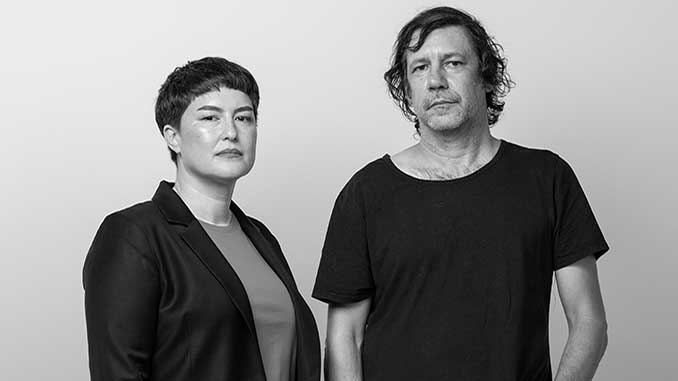



Archie Moore’s kith and kin, curated by Ellie Buttrose for the Australia Pavilion at the 60th Venice Biennale, was conceived as an exploration of Kamilaroi, Bigambul, British and Scottish family histories.
The project connected genealogy with questions of Indigenous sovereignty, language, colonisation, surveillance and incarceration.
Kinship beyond the family tree
Moore drew on the older meanings of the words “kith” and “kin”, linking them not only to friends and family but also to native land and place.
That linguistic history resonated with First Nations understandings in which Country, living things and human relationships belong to an interconnected kinship system.
The work traced Moore’s Kamilaroi and Bigambul ancestry across an exceptionally long historical horizon, setting individual family stories against the continuity of First Nations presence.
Language, loss and survival
Language has been a recurring element in Moore’s practice.
Because colonial dispossession interrupted the transmission of ancestral languages within his own family, he researched Gamilaraay and Bigambul words and incorporated them into his work.
The exhibition also connected family history with Australia’s carceral past. Moore’s British and Scottish great-great-grandfather arrived as a convict in 1820, while a Kamilaroi and Bigambul great-uncle was imprisoned in Boggo Road Gaol.
kith and kin used these intersecting histories to show how family, land, language and systems of power remain entangled across generations.