
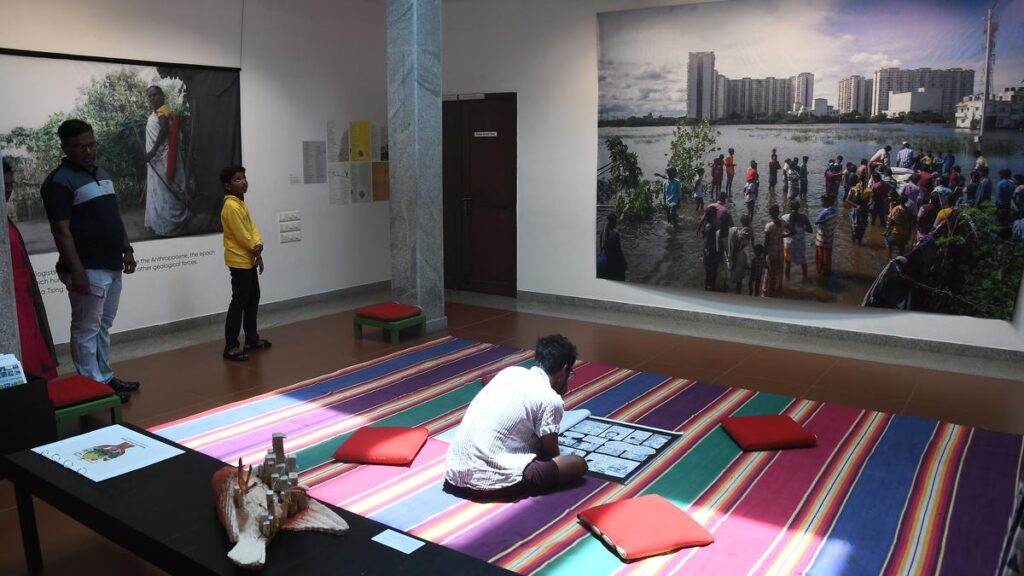



The 2023 exhibition Bhin Bhini examined how climate change was already reshaping livelihoods, landscapes and everyday survival across India.
Presented at DakshinaChitra near Chennai, the exhibition combined sculpture, photography, graphic narrative, video and archival material.
Local images carrying a global crisis
Prithvi Raj wrapped red cloth around trees outside the gallery to draw attention to their living presence.
M. Palani Kumar photographed residents of Semmencheri recovering a car from floodwater.
K. Madhavan created a ceramic sculpture about agricultural land shrinking under urban development, while Hari Ganesh painted birds disappearing from areas including Chennai’s Radial Road.
Pritha Umapathy studied a century of satellite maps and translated changing land mass and rising sea levels into a series of hand-drawn maps.
An archive made physical
Curator Krishnapriya CP worked with material from the People’s Archive of Rural India, the Foundation for Indian Contemporary Art and The Forest Way.
Photographs were printed at different scales and on varied materials so that visitors encountered the archive spatially rather than as a flat documentary record.
A reading room presented images and conversations about agriculture, labour, tools and natural resources.
Sessions developed with Marudam Farm School extended the exhibition into climate education for younger audiences.
Bhin Bhini linked environmental change with work, migration and food production.
The exhibition resisted abstract images of planetary crisis by concentrating on people and species whose conditions had already changed. Its varied media made climate instability visible as a lived social reality rather than only a future forecast.