
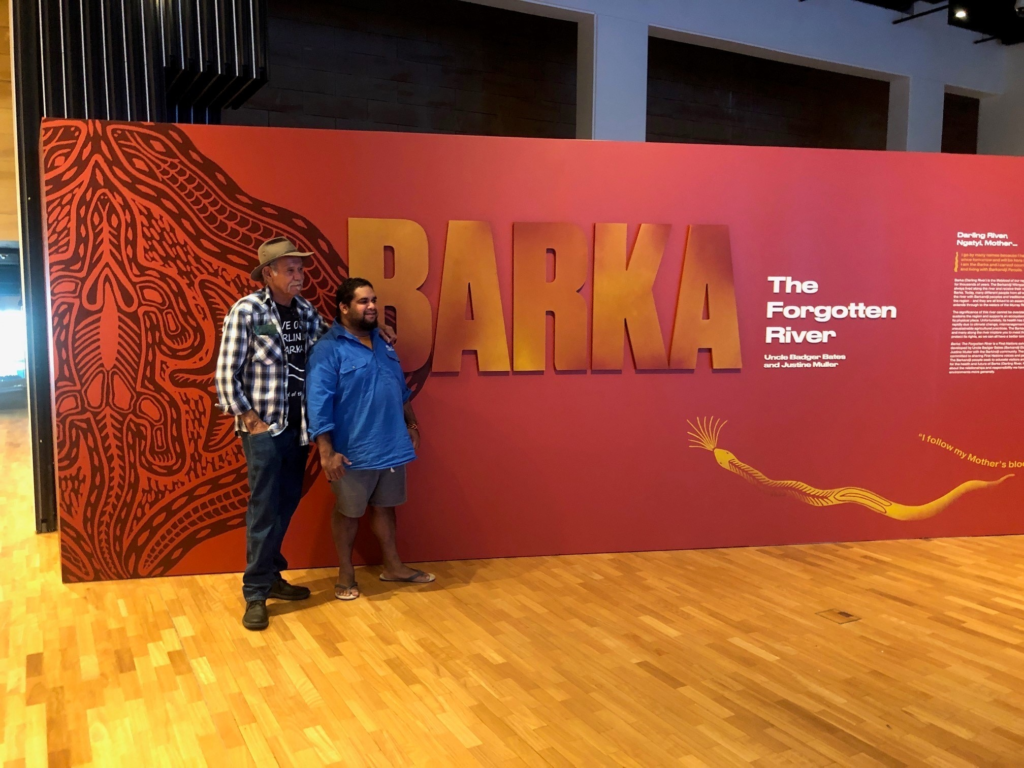


An art exhibition depicting the cultural connection between the Darling River and the Indigenous peoples who have lived on its banks for thousands of years opens at the Australian Museum in Sydney today.
Key points:
Pieces featured in ‘Barka: The Forgotten River’ will include a range of disciplines, from footprint impressions in river clay to oil paintings and multi-media installations.
The exhibition was first created about five years ago by Barkandji elder Badger Bates of Wilcannia and Sydney-based artist Justine Muller.
Mr Bates said the idea behind it was to showcase the importance of the Darling River to local Aboriginal communities and the need to protect it.
“We as Barkandji people take our name from the river, from the Barka … without the Barka we got nothing,” Mr Bates said.
“If they kill our river, they kill everything that lives in that river and everyone who lives on that river.
“[The exhibition is about] what’s happening to the river but also to the environment and to the people living along the river.”
Journey to the national stage
Co-creator Ms Muller described conceiving the exhibition as a very organic process, with the first piece being a portrait she painted of Mr Bates when her car broke down in Wilcannia.
“Uncle Badger then invited me to return to Barkandji country and to continue that collaboration to work with him,” she said.
“I guess our work has a language that talks to each other … we’ve grown up with very different backgrounds, but we have a common interest in protecting the Barka.”
After taking around three years to compile it, Barka: The Forgotten River made its debut at the Broken Hill art gallery in 2018.
In the years since, it has toured to several other galleries across Australia, including ones in Adelaide, Canberra, Mildura, and Maitland.
To prepare for the national stage, Mr Bates made some additions to the exhibition, including sculptures depicting native river water birds carved from river red gum that grows along the Darling.
Meanwhile, Ms Muller’s contributions include a range of portraits and audio files depicting locals in Wilcannia talking about their love of the river and their observations of its declining health over time.
“The museum has been absolutely incredible to work with, even though the exhibition has been touring for four years, it’s kind of a re-imagined version,” she said.
Future not guaranteed
A range of people from Wilcannia, including those depicted in the work, have been flown out by the museum to attend the exhibition’s opening this week.
Today’s opening will also feature performances from Barkandji musicians Barkaa and Leroy Johnson, a mussel carving demonstration with David Doyle, jewellery making with Barbara Quayle, and a wood carving demonstration from Anthony Hayward.
The showing at the Australian Museum is expected to last around two to three months, and Mr Bates said it may be the exhibition’s last.
“We [might] have to pull it apart [because] we can’t get any funding. We can’t get any grants because it’s considered too political,” he said.
“[But] this exhibition is going to be the best one, it’s got a lot of stuff in it.
“I hope people go and see it and think about the environment [rather than] the two artists [behind it].”
Local news direct to your inbox
This content was originally published here.