
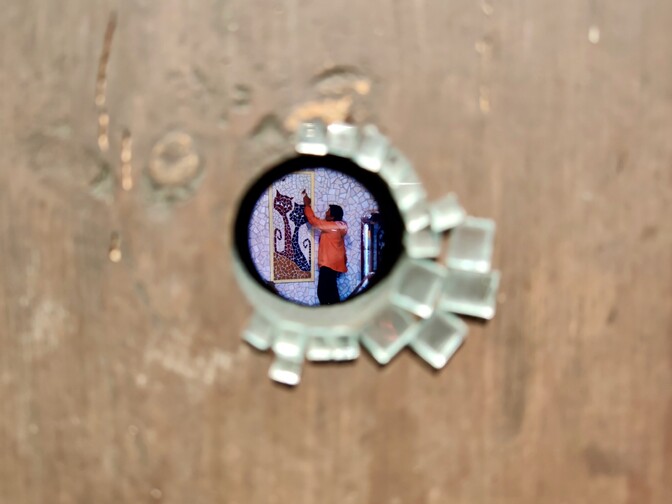


With an exhibition of their work now open at the Estonian Academy of Arts (EKA) Gallery in Tallinn, ERR News spoke to Martínez to find out more.
“Basements are the backstage of a home,” says Francisco Martínez, an anthropologist at Tampere University. “The objects ‘kept in the dark’ [there] are symbolic carriers of history, but also act in the present. Often, they are kept with the intention of perpetuating some ideas and relations. Nevertheless, their effect and meaning are always felt in the present.”
“For the installation, I ‘extracted’ a series of items to be displayed along with their corresponding subterranean biographies,” Martínez explains. “Some of these objects are about family relations, some others are holy and ideological, and there are also emotional memorabilia, preserved because of their associations with childhood.”
What all these objects have in common, is that until recently, their owners had, for one reason or another, decided not to put them openly on display, but still chosen to keep them, only “in the dark.”
Martínez says that people often use basements to conceal as well as to regulate the level of intimacy connected to the objects they choose to present more publicly upstairs in their homes. “In doing so, basements allow people to perform a hybrid identity,” he says. And, for an ethnographic researcher attempting to “capture the actual structure of feeling in the region, the one over thirty years after the Soviet collapse ” in eastern Estonia, this provided a golden opportunity.
“I noticed a gap between the ‘front stage’ and ‘back stage’ behavior of locals, one that is hard to account for simply with language and [through] participant observation,” Martínez explains.
“In many ways, Ida-Viru County is itself a meta corner, a center out there, a social laboratory. It remains a region in need of theorization. Approaches like decolonial, postcolonial, post-socialist or postindustrial are not enough to explain the social relationships here.”
At the same time, he highlights the importance of approaching towns in Ida-Viru County “as normal places, as locations where people continue living, walk their dogs, put gas in the car, water their plants, buy ice-cream or invite you for a cup of tea.”
To that end, he began working with artists Anna Škodenko, Darja Popolitova and Viktor Gurov three years ago, when they created the exhibition “Life in Decline,” at the Estonian Mining Museum in Kohtla-Nõmme, Ida-Viru County. They have since teamed up for several other projects, with “Keeping Things in the Dark, Again,” the latest outcome of their work.
“By collaborating with artists and organizing exhibitions, we were able to stage these shadows and secrecy, which are nonetheless constitutive of social order,” says Martínez, adding that in the process he gained a deeper understanding of how these objects relate to facts from both the present and the past.
In one sense, they show how Ida-Viru County is integrated within the global production and distribution of energy and how it is placed as an ‘other’ within in the nation state.
“On the other hand, to the tragic 20th century, characterized by the Communist modernization process, intensive extraction of natural resources, the relocation of entire communities and military destruction,” he explains.
A major advantage of working with skilled artists on a project like this is their ability to present the outcomes of ethnographic research in a visual way, reaching other audiences outside purely academic circles.
That has also had an impact on his own approach to the subject. “Once you start curating and creating art, you have to unlearn your disciplinary background. In other words, not remaining an anthropologist in some of the stages of the research and borrowing other epistemic positions instead.”
But before they could gather items to display in an exhibition, they first needed to convince local people to let them take a look at what they had been keeping “in the dark.” And, as Martínez explains, that was often no easy task.
“We did not meet any white rabbit beckoning us into Wonderland,” he says, pointing out that some people’s reactions were rather skeptical to say the least.
But, eventually we got access to the basements through friends of friends, who then put us in contact with other friends.”
Perhaps unsurprisingly though, there were also a fair few misunderstandings along the way. “In Narva-Jõesuu, [some] local neighbors thought that we were robbers checking what was where in order to steal it,” he says. “In another instance, [a local called] Nikolai thought I was a secret police officer.”
Then there was the case of Boriss (Borya). “We had agreed to visit his basement in Narva, however he cancelled an hour before our meeting. Months later, Boriss explained that his mum had come to visit him that day and asked ‘what’s your plan for today, Borya?’ So, he said: ‘there is a guy coming to see my basement, he’s an anthropologist, or something, a foreigner.'”
Apparently “horrified at the idea of showing the basement to a stranger,” Boriss’ mother put her foot down, leaving her son with no choice but to pull the plug.
In Sillamäe, things took an even more extreme turn, when they received a surprise gift from a member of the public in response to an earlier version of their exhibition.
“A person waited for us at the entrance of the Sillamäe Museum with a present – a pig’s heart in a plastic bag, as, in her view, ‘we had no brains and no heart,” says Martínez. “All that, because she saw on TV that an icon of St. George the Victorious [in the exhibition] was displayed horizontally instead of vertically.”
Despite these setbacks, they persevered, continuing to visit different places in the region, “from energy factories to bunkers, dachas (country houses – ed.), concerts and museums, spending time there, talking to people, and exchanging ideas between us.”
Eventually, some of the people they encountered even began to reconsider the value of their basements as a result of the interest now being shown in them by strangers. “In some cases, the research [also] acquired a performative aspect,” with residents deciding to clean up their basements and put a few items on display especially for their curious visitors.
But what attracted him to investigate this frequently misunderstood corner of Estonia in the first place? And why does it remain so compelling?
To answer that question, Martínez tells the story about when he met Aleksandr Popolitov, founder and chief curator of the Sillamäe Museum, back in 2017, while searching for old postcards of the region.
“Those who have worked with him know that Aleksandr was very protective of the collection that he managed to put together in the Sillamäe Museum. So, after interrogating me about the purpose of the project, he asked me directly: “And why has someone from Spain come to talk about Sillamäe?” Puzzled by the question, I was only able to say that I was studying this town in the same way as I would observe any other in Bolivia, Kazakhstan, or China.”
In hindsight, Martínez says a better answer would have been that he came to Sillamäe to understand the limits of Soviet modernity, and that the town provides interesting nuances to facilitate that learning.
“I recall this episode not just because I failed to give him a good answer, but also because Aleksandr evidenced that I was considered to be an outsider, a stranger.”
“And yet, I have felt at home in Ida-Viru County,” he says. “Perhaps because this region is largely populated by other outsiders and strangers.”
Now, for what is the final exhibition in their trilogy, four new works have been created.
Anna Škodenko engaged with a time capsule hidden in the ‘Glory to Labor,’ monument, containg a message for people living in Kohtla-Järve. It was supposed to be opened in 2046 but was accidentally unearthed in 1996.
Darja Popolotiva reanimated the myth of “Kratt,” a workaholic mythological creature who destroys itself when its creator entrusts it with an impossible task, now sculpted from fragments of oil shale.
Viktor Gurov reproduced the experience of descending a staircase and stepping into a cellar, with fumage aesthetics on the ceiling.
And Martínez, in collaboration with Riina Varol, revised the archival material of Enas Amerkhanov, who documented life in Kulgu, (known locally as “Narva Venice”) between 1972 and 1987.
The collectively curated art exhibition “Keeping Things in the Dark, Again” opened at the Estonian Academy of Arts (EKA) Gallery in Tallinn on Friday, September 22. Visitors can see the exhibition until October 25. More information is available here.
Follow ERR News on Facebook and Twitter and never miss an update!
This content was originally published here.