
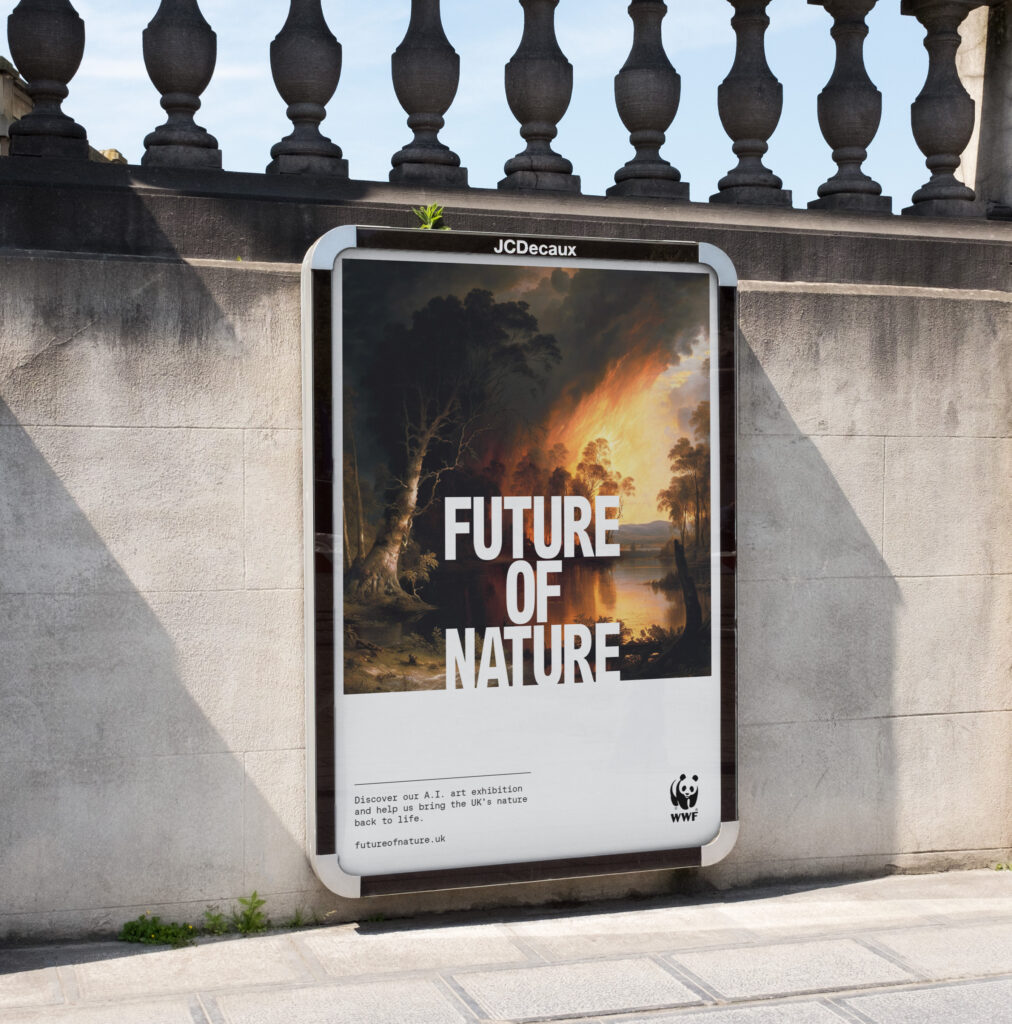

WWF’s 2023 exhibition used artificial intelligence to imagine two opposing futures for nature in the United Kingdom.
Created with Uncommon Creative Studio, the images adopted the visual language of British Romantic painting while depicting environmental scenarios grounded in contemporary risks.
Landscapes of destruction and repair
Highland Wildfires (2034) showed an ancient woodland burning. Sussex Landfill (2067) imagined an overflowing landscape of waste, while Innocents (2023) referred to the three porpoises estimated to be killed each day in UK waters.
Other images presented more hopeful possibilities. Spring in Ingleborough (2023) depicted a rambler moving through the Yorkshire Dales, and Turbines (2075) imagined a green landscape shaped by renewable energy.
Each fictional work was dated and accompanied by information about the real environmental conditions that informed it.
Historical style applied to future evidence
British Romantic artists often presented nature as powerful, sublime and emotionally charged. The project borrowed that language to ask how painters associated with the movement might have represented future ecological collapse or recovery.
The exhibition did not claim that the images documented real places. Their purpose was to make scientifically plausible futures feel visually immediate.
The work also reflected the growing use of generative systems within environmental communication. Human organisers selected the scenarios, framed the argument and chose the final images, while the software produced visual variations.
Displayed in advance on the Piccadilly Lights, the project used a highly visible commercial screen to present nature loss as a public issue.
The exhibition’s central contrast was deliberately simple: environmental decline was not presented as inevitable, and restoration was not presented as automatic. Both futures depended on decisions made in the present.