
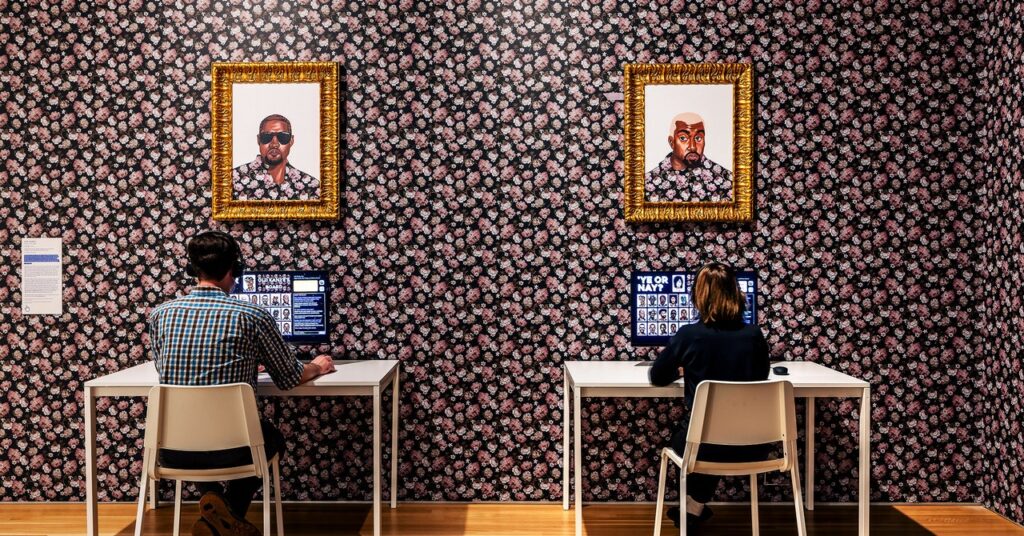



Difference Machines: Technology and Identity in Contemporary Art brought together 17 artists whose work examined how digital systems shape race, gender, surveillance and social identity.
Presented at Wrightwood 659 in Chicago, the exhibition treated video games not simply as entertainment but as artistic material, social environment and critical tool.
Games as spaces of participation
A.M. Darke’s two-player game Ye or Nay? used a structure inspired by Guess Who? while replacing the familiar faces with Black male celebrities.
Players had to describe and categorise the figures through an in-game chat, making visible the language and assumptions involved in classification.
The work connected everyday acts of recognition with the way databases and algorithms sort people into categories.
Building Indigenous futures inside virtual worlds
Skawennati used the online world Second Life to create machinima, films produced inside game environments.
Her 2017 work She Falls for Ages retold an Iroquois creation story in a futuristic setting, using digital space to imagine Indigenous people in the future rather than confining them to historical representation.
Using commercial games against themselves
The collective Total Refusal approached mainstream games as ready-made cultural landscapes.
In works such as Operation Jane Walk and Hardly Working, the artists redirected violent or commercial game worlds toward questions of architecture, labour, capitalism and social organisation.
Difference Machines showed that contemporary artists are not only adopting video-game technology. They are also testing the assumptions built into its images, rules and systems of interaction.
In that context, the game becomes both medium and subject: a place where identity is performed, categorised and contested.