For 50 years Timboon Field Naturalists Club chair Helen Langley has been fostering a community of enthusiasts who see the world a little differently. One of the club’s founding members, Ms Langley said she was thrilled the small group had reached the major milestone. “It’s just wonderful,” she said. “It has always been small – extremely small at times – but I’m just thrilled that we’ve made 50 years and we have as many people or even more now than when we first began. “It’s wonderful visiting an area with naturalists who all have sharp eyes and see things a lot of people don’t notice. “They all have slightly different interests, there’ll be one more focused on birds and the person walking beside them will be focused on fungi. “Whatever’s in front of us whether it’s the rocks beneath our feet or the atmosphere above our heads, we’re interested in all of those.” To celebrate, an art space has been set up at Port Campbell and will be on display until Wednesday featuring photographs, wooden sculptural pieces, textiles and paintings. IN OTHER NEWS Ms Langley said it was all the work of members who’d kept the group strong over the years. “It definitely has as many active members as when it first began and on our email list we have more people again which is just fabulous – there’d be about 20 people,” she said. “It started when a school teacher who’d been in other areas where there were clubs came to Timboon and realised we were a beautiful natural area without one so contacted some of the locals, talked to them and formed the club. “Now we aim to have an outing every month where we pick somewhere to go like the bush or the coast. We’ve also had some excursions further afield – we took a bus to Budj Bim and had a tour there and we took a bus to Geelong to see the wildlife photographer of the year exhibition. “We’re only a small club but we’re part of a bigger group called the South-East Australian Naturalists Association and twice a year we join other naturalists groups around Victoria and camp together. “The most recent one was Portland and at this time next year we’ll be hosting possibly 100 naturalists all around Victoria at Port Campbell.” Our journalists work hard to provide local, up-to-date news to the community. This is how you can access our trusted content:
Timboon Field Naturalists Club celebrates 50 years with art exhibition in Port Campbell
For 50 years Timboon Field Naturalists Club chair Helen Langley has been fostering a community of enthusiasts who see the world a little differently.
One of the club’s founding members, Ms Langley said she was thrilled the small group had reached the major milestone.
“It’s just wonderful,” she said.
“It has always been small – extremely small at times – but I’m just thrilled that we’ve made 50 years and we have as many people or even more now than when we first began.
“It’s wonderful visiting an area with naturalists who all have sharp eyes and see things a lot of people don’t notice.
“They all have slightly different interests, there’ll be one more focused on birds and the person walking beside them will be focused on fungi.
“Whatever’s in front of us whether it’s the rocks beneath our feet or the atmosphere above our heads, we’re interested in all of those.”
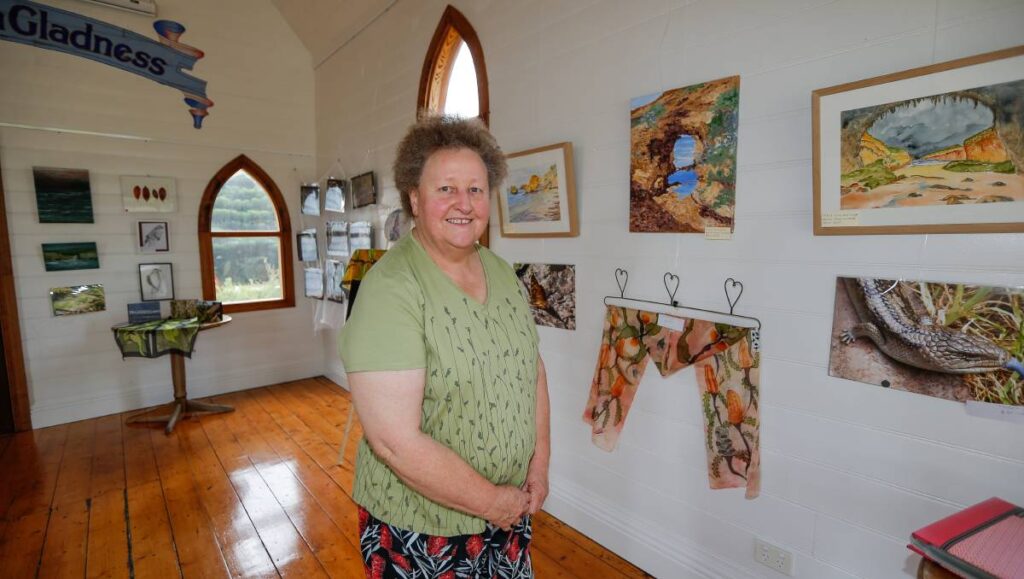
To celebrate, an art space has been set up at Port Campbell and will be on display until Wednesday featuring photographs, wooden sculptural pieces, textiles and paintings.
Ms Langley said it was all the work of members who’d kept the group strong over the years.
Helen Langley.
“It definitely has as many active members as when it first began and on our email list we have more people again which is just fabulous – there’d be about 20 people,” she said.
“It started when a school teacher who’d been in other areas where there were clubs came to Timboon and realised we were a beautiful natural area without one so contacted some of the locals, talked to them and formed the club.
“Now we aim to have an outing every month where we pick somewhere to go like the bush or the coast. We’ve also had some excursions further afield – we took a bus to Budj Bim and had a tour there and we took a bus to Geelong to see the wildlife photographer of the year exhibition.
“We’re only a small club but we’re part of a bigger group called the South-East Australian Naturalists Association and twice a year we join other naturalists groups around Victoria and camp together.
“The most recent one was Portland and at this time next year we’ll be hosting possibly 100 naturalists all around Victoria at Port Campbell.”
Our journalists work hard to provide local, up-to-date news to the community. This is how you can access our trusted content: