
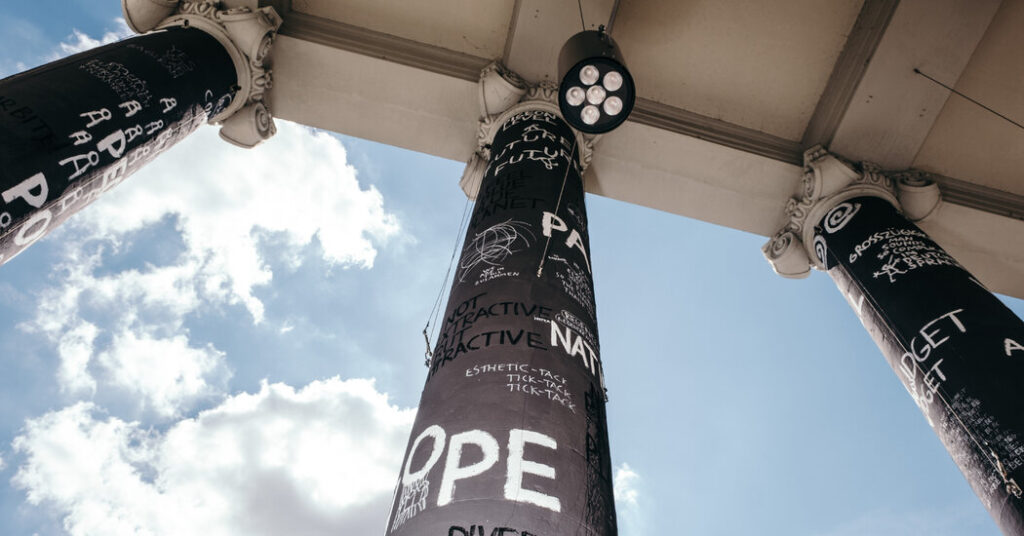


Documenta 15 ended in 2022 under a combination of institutional scandal and critical disagreement about the exhibition’s emphasis on collectivity over individual artworks.
Curated by the Indonesian collective ruangrupa, the edition organised much of its programme around shared activity, informal exchange and artist-led groups.
When participation became the central medium
The exhibition frequently presented archives, workshops, banners, films and spaces for gathering. Its catalogue declared that “the viewer is obsolete,” reflecting an approach in which relationships and collective processes could matter more than objects displayed on a wall.
For supporters, this model challenged the hierarchy and market focus of large international exhibitions. For critics, it made the work difficult to assess and sometimes allowed weak presentation to be protected by the social value claimed for the process.
One prominent critique argued that friendship, advocacy and participation had been treated as sufficient artistic outcomes. It contrasted that emphasis with expectations of aesthetic ambition, intellectual rigour and meaningful public encounter.
A damaged claim to global representation
Documenta had long attempted to provide an international view of contemporary art every five years. The 2022 edition exposed the difficulty of sustaining that ambition within a world marked by competing histories, political demands and unequal institutional power.
The controversy over antisemitic imagery further damaged trust in the exhibition and overshadowed discussion of many works.
Critics predicted that a future edition might respond with a more conservative or market-oriented programme. More broadly, the debate raised a question that extended beyond Documenta: whether a global exhibition could still create productive encounters across disagreement rather than becoming a collection of separate communities.
Documenta 15’s legacy was therefore not limited to the quality of its individual works. It became a test of whether collectivity, curatorial responsibility and artistic judgement could coexist within one highly visible institution.