
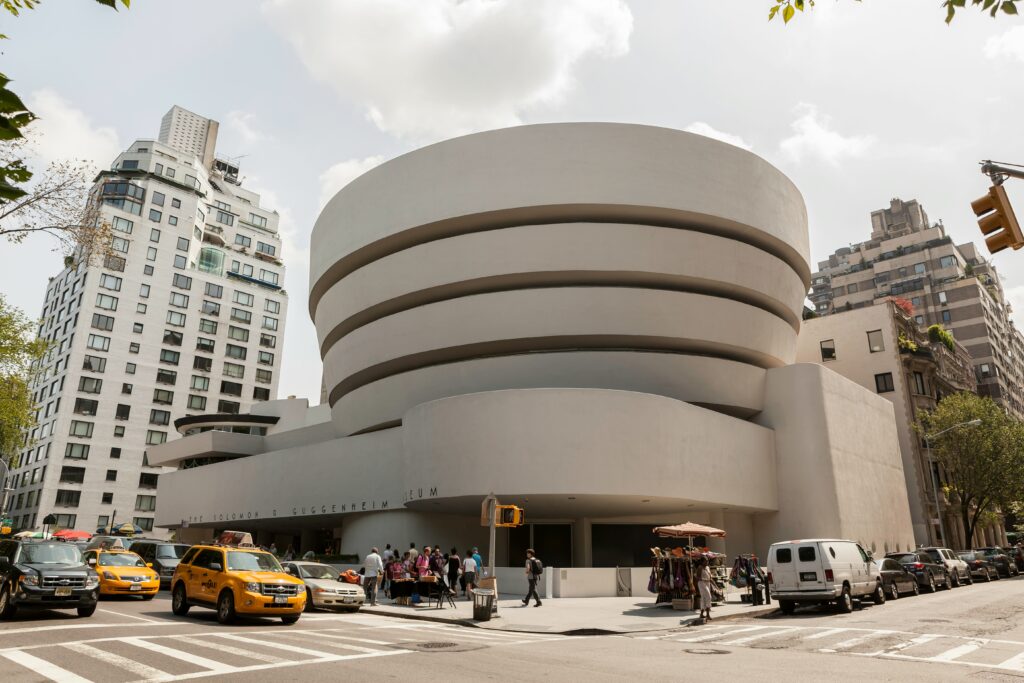
On September 18, Taryn Simon opened Father Country I Do Love You at New York’s Solomon R. Guggenheim Museum, filling Frank Lloyd Wright’s rotunda with a project nearly a decade in the making. Across 42 multipart chapters, photographs, text, video and sculpture reconstruct the life of an unnamed federal agent—and, through him, a shadow history of American power.
The exhibition begins with the materials of a biography but quickly makes biography unstable. Simon follows assignments, procedures and personal fragments whose meanings are never entirely fixed. A political sting involving Washington mayor Marion Barry, the 1998 bombing of the United States embassy in Nairobi and the training culture surrounding the Federal Bureau of Investigation enter the work as connected episodes rather than a settled chronology.
A life assembled as evidence
Simon has long worked at the border between the visible and the withheld. Here, the exhibition’s scale turns that method into an architecture: viewers move through a life that appears exhaustively documented while remaining partly inaccessible. The agent is present through traces, official systems and staged acts, yet his identity is protected. The resulting tension asks what an archive reveals, what it conceals and who is authorized to interpret it.
One chapter features Jodie Foster reenacting a color-coded fingerprinting exercise associated with the preparation for her role in The Silence of the Lambs. In a conversation published by Vanity Fair, Simon and Foster describe how performance and institutional procedure can fold into one another. The sequence is less a celebrity cameo than a demonstration of how authority is rehearsed, circulated and remembered.
The work is also personal. Simon dedicates it to her father, whose enigmatic government work and later experience of Alzheimer’s made secrecy and erasure intimate concerns. A recent Vogue profile situates the project within that family history, while TIME has highlighted Simon’s broader influence on contemporary image-making.
The rotunda becomes a system
Installed along the Guggenheim’s ascending spiral, the chapters resist a single beginning or conclusion. The museum’s famous continuous ramp becomes both viewing device and bureaucratic circuit: information accumulates, doubles back and changes meaning as the visitor climbs. That spatial logic suits an artist whose practice treats classification itself as a subject.
Father Country I Do Love You is Simon’s largest presentation of new work to date. It arrives at a moment when the language of national security, surveillance and institutional trust is again being contested in public. Yet the exhibition avoids the explanatory ease of a dossier. Its power lies in keeping evidence active—precise enough to persuade, incomplete enough to demand scrutiny.
The exhibition continues through March 14, 2027. An accompanying publication from Hatje Cantz extends its constellation of images and records beyond the museum.
Image credit: Solomon R. Guggenheim Museum, New York—a contextual view of the venue, not an installation image of Father Country I Do Love You. Photograph by Reno Laithienne via Unsplash, used under the Unsplash License.