
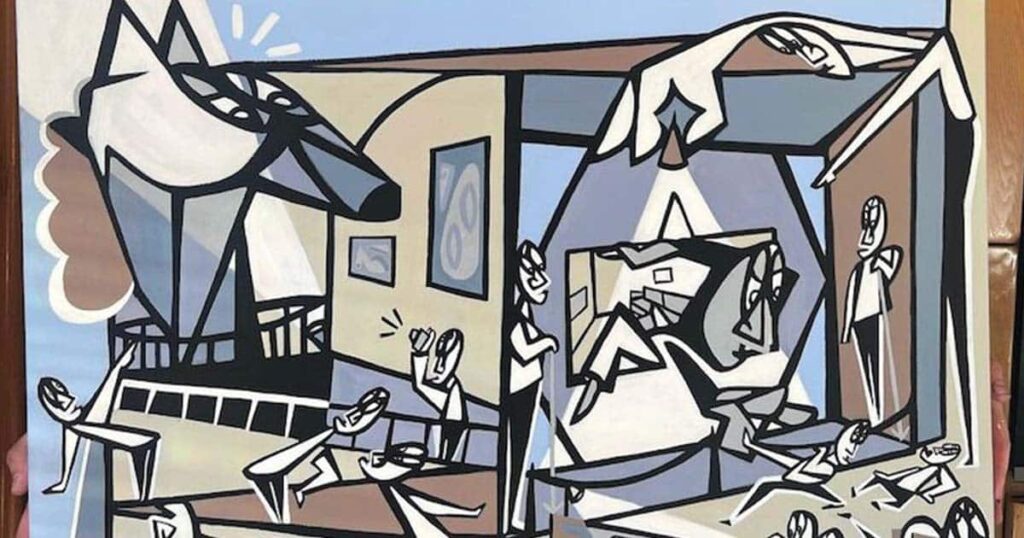


Artist Justin Bunting turned the idea of an exhibition into the subject of a painting, constructing a chaotic museum scene in which the boundaries between artworks and visitors collapse.
Known for bold black outlines, flattened colour and stylised figures, Bunting draws on modern painting, graphic design and mid-century visual culture.
An exhibition inside the painting
In the work, visitors occupy a retrospective display while the objects around them begin to behave independently.
A horse sculpture watches a painting thief. Elsewhere, a figure climbs out of the exhibition’s central painting and reaches toward the thief, knocking over visitors in the process.
The scene creates a deliberately unstable relationship between the gallery, its audience and the art it is meant to contain.
Borrowing from art history without reproducing it
Bunting’s compositions use a restricted palette, heavy outlines and fractured bodies that recall several strands of twentieth-century modernism.
His references extend beyond painting to furniture, architecture and mid-century graphic design.
Those influences are treated as a visual vocabulary rather than as models to copy directly.
The imagined retrospective is particularly self-aware: Bunting uses the gallery as both setting and joke, turning the difficulty of getting work exhibited into material for another artwork.
The result is a painting about looking at paintings, but also about what happens when the supposedly passive objects in a gallery begin to control the narrative.