


London’s Victoria and Albert Museum opened The Burberry Trench: Crafting an Icon on 21 September 2026, placing a familiar coat at the centre of a design-history display. The free exhibition in the Prince Consort Gallery traces the garment from weatherproof workwear and military dress to a canvas for successive fashion designers. It arrives during London Fashion Week and Burberry’s 170th anniversary, but the museum’s account is broader than a seasonal collection.
At its starting point is gabardine, the closely woven fabric associated with founder Thomas Burberry. As the exhibition describes, a practical answer to wet weather gradually became an object with a remarkably adaptable silhouette. The V&A brings material from its own holdings together with the company’s archive, allowing the trench to be read as an object shaped by technique, changing social use and fashion imagery.
From field coat to fashion object
Historical pieces anchor that chronology. The display includes a womenswear catalogue featuring trench coats from about 1937 to 1944 and the personalised label inside a Burberry car coat owned by British designer Hardy Amies. The Guardian reports that a military overcoat worn by an army lieutenant colonel in 1939 is also present. Those items place the coat’s later glamour beside the practical and institutional histories from which it emerged.
W Magazine, reporting on the opening, notes that Burberry coats appeared at the V&A in 1946 in a display about British design and manufacturing. Its account of the new presentation follows the garment through First World War use, the arrival of the recognisable check and its appearances in fashion photography. The earlier museum appearance makes the 2026 display more than a brand anniversary: it is also a return to a long-standing question about how industrial design enters cultural collections.
A gallery of reinventions
The second half gives the silhouette room to change. Among the V&A’s highlighted objects are a pink metallic silk trench from spring/summer 2013, a mirror-embroidered men’s coat from autumn/winter 2015 and a purple baroque-print fringed example from winter 2025. W Magazine describes nearly two dozen runway variations, including a ballgown interpretation associated with Riccardo Tisci. Seen together, these works suggest that recognisability can enable experimentation as well as impose limits.
The presentation also has a contemporary commercial context. Burberry closed London Fashion Week on the same day with a collection involving textile designer Celia Birtwell; The Guardian reported that its runway included fluid trench shapes and floral treatments. The museum display, however, turns attention from what can be bought now to how a design accumulated meanings over more than a century.
The Burberry Trench: Crafting an Icon is free to visit at the V&A in South Kensington until 3 January 2027. By moving from archival catalogues to extravagant runway objects, it asks visitors to look again at the coat’s construction and at the shifts in taste that have kept its outline legible.
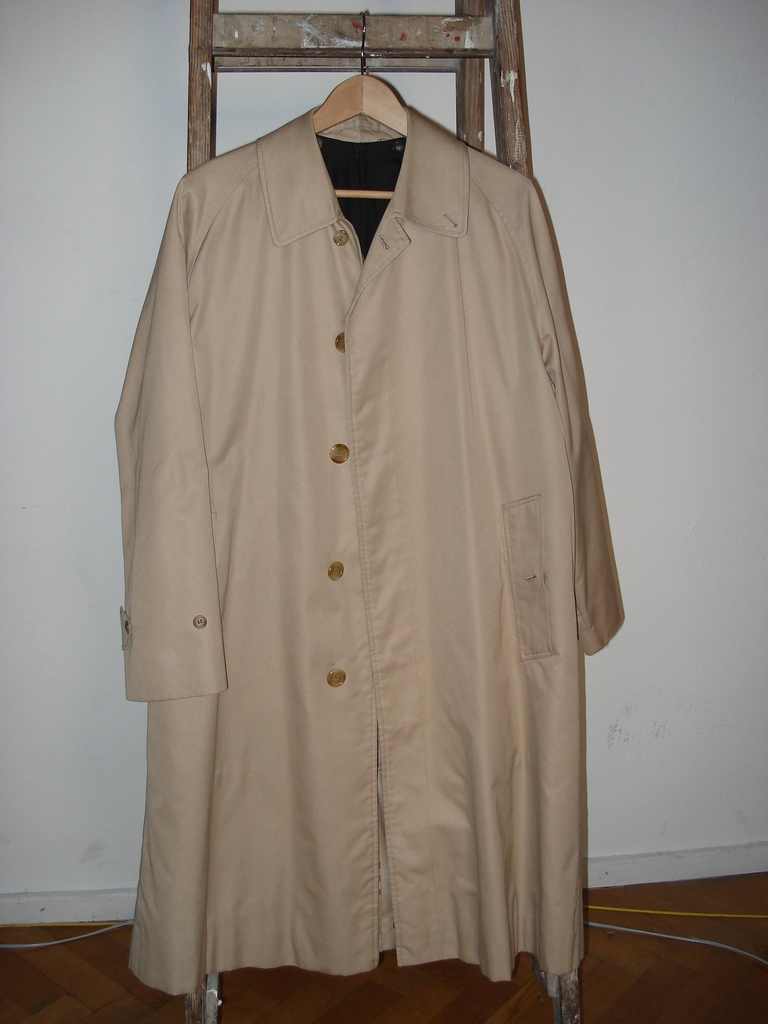
Image: A Burberry trench coat photographed in 2009 by MB-one. Contextual photograph, not a view of the 2026 V&A exhibition or a coat identified as part of its display. Wikimedia Commons, CC BY-SA 2.0; no alterations.
