
Los Angeles gained a new museum—and a new argument about what belongs in one—when the Lucas Museum of Narrative Art opened to the public on 22 September. A sold-out crowd entered the biomorphic building in Exposition Park, where George Lucas and Mellody Hobson greeted the first visitors after nearly two decades of planning, relocation and construction.
Founded around Lucas and Hobson’s collection, the institution calls itself the first museum devoted to visual storytelling across cultures and centuries. That definition is deliberately broad. The inaugural installation moves from prehistoric image-making to painting, illustration, comics, photography, murals and cinema, treating popular images as evidence of how societies imagine themselves.
A collection that refuses hierarchy
More than 100,000 square feet of exhibition space are divided among over 30 galleries. The museum says visitors encounter artists ranging from Artemisia Gentileschi and Frida Kahlo to Norman Rockwell, Robert Colescott, Frank Frazetta and Robert Crumb. El País reported that roughly 1,200 works are on view, with Picasso, Banksy and Darth Vader sharing the same institutional frame.
That mix makes the Lucas Museum more than the Star Wars shrine many expected. A dedicated gallery does draw on the Lucas Archives for designs from the first six films, but cinema is only one strand in a collection of some 40,000 objects. Condé Nast Traveler describes a museum that pairs familiar cultural icons with overlooked commercial and narrative artists, collapsing distinctions that conventional art history often protects.
The gamble is also the museum’s central critical question. Calling these objects “people’s art” can illuminate how images shape belief, but abundance alone does not produce interpretation. The success of the displays will depend on whether the museum can make its juxtapositions legible without smoothing over the political and commercial forces behind them.
Architecture as a public argument
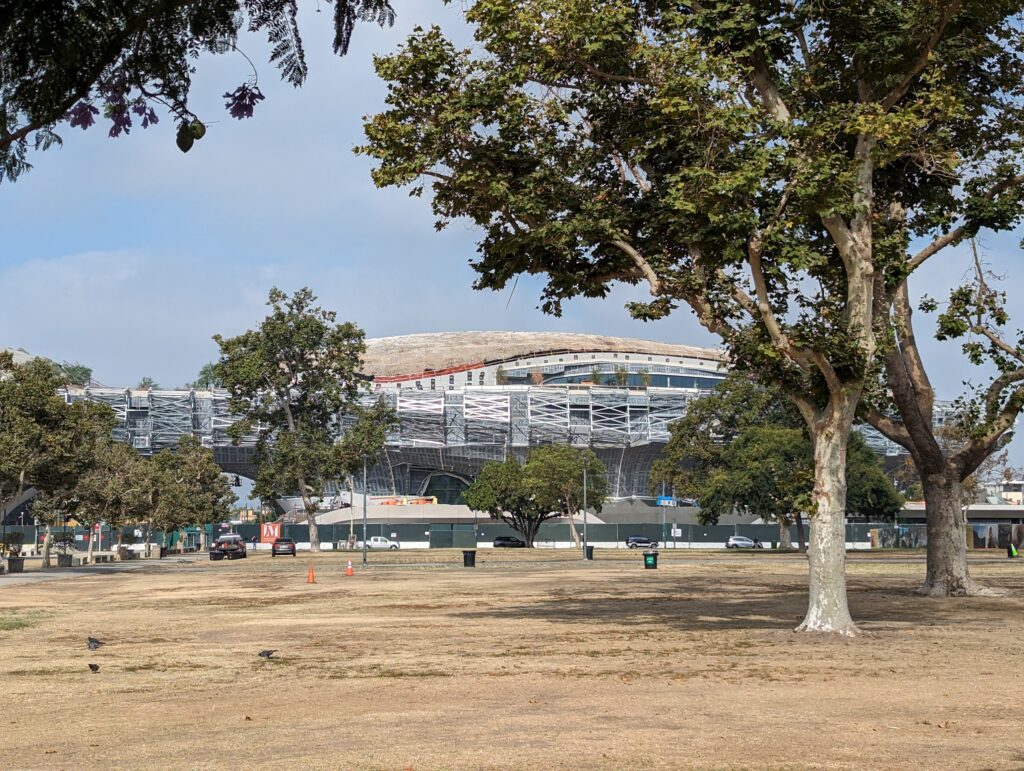
Designed by Ma Yansong’s MAD with Stantec, the 300,000-square-foot building curves above a new landscape rather than standing as a conventional box. Its elevated form frees ground for parkland and gardens designed by Mia Lehrer’s Studio-MLA. Eleven acres of green space, ten outdoor sculptures, two theatres and a free research library extend the institution beyond its ticketed galleries.
Opening day emphasized that civic ambition. More than 100 students from Los Angeles colleges received free tickets for the ceremony, while residents of the surrounding 90037 ZIP code can access the museum without charge. The gesture matters in South Los Angeles, where a privately founded cultural landmark now occupies land once dominated by parking lots.
The Lucas Museum arrives with scale, celebrity and an unusually inclusive definition of art. Its real test begins after the opening crowds: whether its vast collection can turn visual familiarity into critical attention, and whether the building can become the shared public space its founders have promised.
Image: The Lucas Museum of Narrative Art under construction in August 2023. Photograph by Jeremy Thompson, via Wikimedia Commons, licensed under CC BY 2.0. The image predates the museum’s opening and does not show the completed building or the 2026 opening day.