

On Sunday, November 8, Berlin’s Brücke-Museum opened Swedish Modernism with a public afternoon that brought diplomats, curators and visitors together around a movement Germany has rarely seen at this scale. The exhibition, formally on view from November 9 to February 28, 2027, gathers 70 paintings and drawings from Stockholm’s Moderna Museet. Most are being shown in Germany for the first time.
A northern avant-garde returns to Berlin
The return carries historical weight. In 1915, Berlin’s Galerie Der Sturm presented artists from Sweden as “Swedish Expressionists.” More than a century later, the Brücke-Museum’s new survey reconnects those painters with a German audience and places their experiments beside the anti-academic urgency associated with Brücke.
The exhibition focuses on three overlapping constellations: De Unga, or “The Young Ones”; De åtta, “The Eight”; and the Gothenburg Colourists. Their members did not form a single school. They shared a refusal of settled academic rules, then pushed colour, line and psychological intensity in markedly individual directions. French modernism also runs through the story, with Henri Matisse appearing among the artists represented.
Sigrid Hjertén emerges as a crucial figure. Her paintings turn interiors, family life and urban experience into stages of saturated colour, registering the competing demands of being a modern woman, artist, intellectual and mother. Isaac Grünewald, Nils Dardel, Leander Engström and Karin Parrow expand the picture, making the show less a rediscovery of one overlooked name than a reconstruction of an interconnected scene.
Berlin critics immediately picked up that argument. Der Tagesspiegel described the avant-garde’s return on opening day, while B.Z. reported from the museum ahead of the public launch. Their attention underscores how unfamiliar much of this work remains outside Sweden, despite its early links to Berlin.
A collection exchange with a wider purpose
Swedish Modernism is the second half of an institutional exchange. In 2024, major works from the Brücke-Museum travelled to Stockholm. Now the Moderna Museet’s holdings have come to Berlin, allowing two collections to illuminate parallel efforts to break from convention rather than treating modernism as a story with one national centre.
That structure also changes the usual logic of a blockbuster. Instead of assembling famous loans around a familiar master, the museums use their own collections to shift the map of European modern art. The result asks viewers to recognise how artists in Stockholm, Gothenburg, Paris and Berlin absorbed similar pressures while building distinct visual languages.
The opening made that international framework visible. Swedish ambassador Veronika Wand-Danielsson joined Brücke-Museum director Lisa Marei Schmidt, Moderna Museet curator Matilda Olof-Ors and exhibition curator Isabel Fischer for the welcome. Their presence gave the exchange a civic dimension without reducing the art to cultural diplomacy.
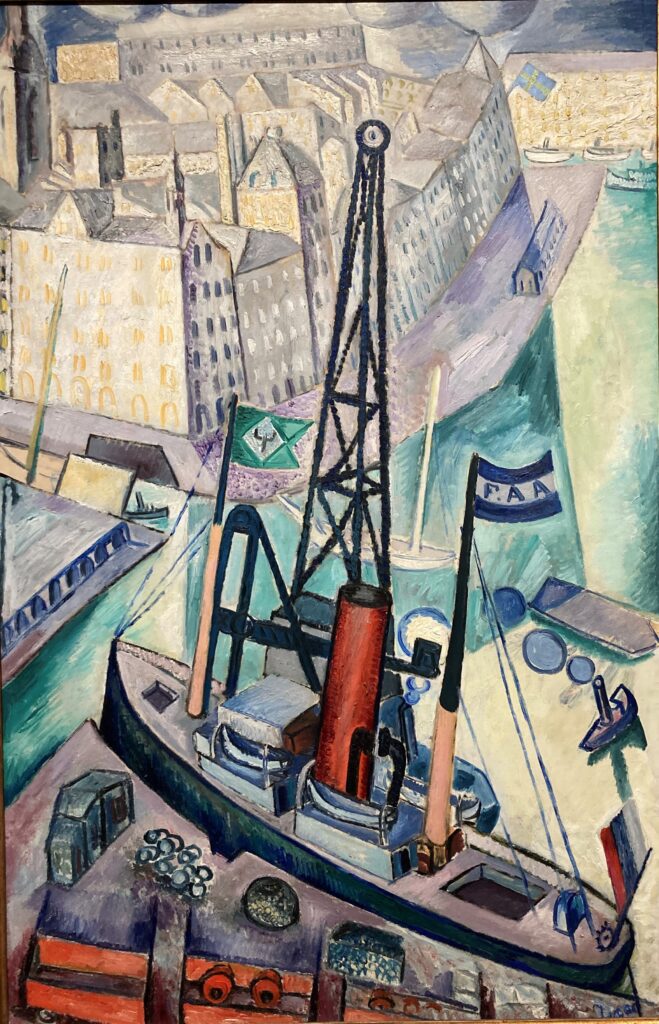
One work captures the show’s energy: Isaac Grünewald’s 1915 Lyftkranen, or The Crane, where industrial structure becomes a vivid arrangement of colour and movement. It is an apt image for an exhibition lifting a neglected chapter of modernism back into view.

Featured image: Isaac Grünewald, Lyftkranen (The Crane), 1915, oil on canvas, Moderna Museet, Stockholm. Photograph: Gotogo, 2022, via Wikimedia Commons, licensed under CC BY-SA 4.0. No editorial changes beyond WordPress resizing. The painting is included in the Brücke-Museum exhibition; this is a collection photograph, not a view of the Berlin installation.