
Washington’s National Air and Space Museum has opened its final renovated gallery, using more than 150 objects to examine how aviation technology changed conflict, diplomacy and the people who made those changes possible.
Modern Military Aviation opened on 11 November at the Smithsonian’s National Air and Space Museum in Washington, D.C. The permanent gallery spans the period from the Cold War to the present, placing aircraft, weapons, cameras and personal material inside a broader account of power, technological choice and geopolitical consequence. Its arrival also returns the museum’s entire suite of 20 galleries to public view after a transformation that began in 2018.
Machines, choices and consequence
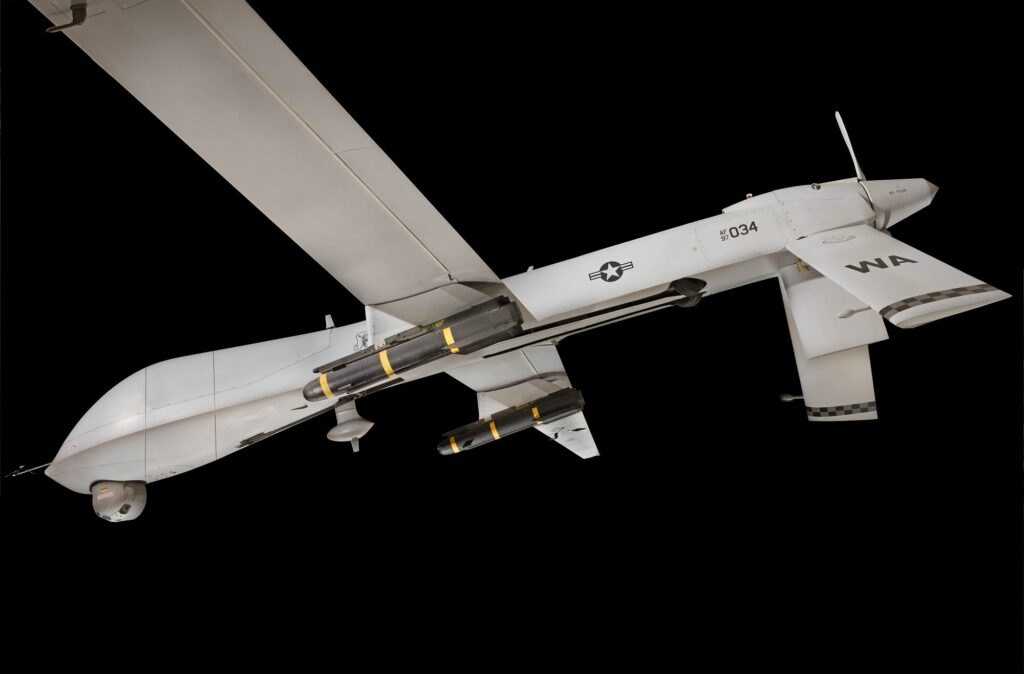
The display is anchored by three machines with very different historical weight: a North American F-86 Sabre, a Bell UH-1H “Huey” and a General Atomics MQ-1L Predator. Together they trace a shift from jet-age dogfights and troop transport to remotely piloted surveillance and precision strike. Yet curator Michael Hankins told Military Times that the gallery’s central proposition is human rather than mechanical: each technology embodies decisions about how it was designed, deployed and remembered.
That approach extends beyond the aircraft. A Hycon B camera links aviation to the Cuban Missile Crisis, when images captured by a U-2 helped reveal Soviet missile sites. A damaged fragment from one of the airliners used in the attacks of 11 September 2001 sits near the Predator, making the chain between trauma, policy and technological response physically visible. Conservation, in this setting, is not neutral storage; it determines how difficult histories can be encountered without being simplified.
The Predator is the gallery’s most unsettled object. The Smithsonian aircraft flew 196 combat missions in Afghanistan and was among the first three unmanned aircraft sent there after the 2001 attacks. It also served as a prototype for an armed system that could combine long-duration surveillance with remote missile strikes. That innovation compressed the time between seeing and attacking a target, while opening lasting ethical questions about distance, civilian harm and accountability.
A museum rebuilt around responsibility
The gallery completes the museum’s long rebuilding project in its 50th-anniversary year. Earlier phases renewed the building’s exterior and infrastructure while reorganising its collections into new narratives. Here, the emphasis on operators, engineers, intelligence staff and conservators resists the seductive tendency to treat machines as autonomous icons. Even the most advanced aircraft is shown as part of an institutional and political system.
Opening on Veterans Day adds another layer to that choice. The display can honour the experience of those who worked with these machines while still asking what their use meant for people beyond the cockpit or control station. By putting human agency back inside technological history, Modern Military Aviation makes a museum of machines answer to the consequences of their design.
Featured image: General Atomics MQ-1L Predator A (A20040180000), photographed at the National Air and Space Museum in 2017. The aircraft is displayed in Modern Military Aviation; the image predates the gallery’s 2026 opening. Photo: Eric Long / Smithsonian National Air and Space Museum, CC0 Open Access.
