

Paris’s Musée du quai Branly–Jacques Chirac opened Silent Violence: Through the Eyes of Roméo Mivekannin on 10 November 2026. The museum confirmed the next day that the exhibition had opened its doors the previous evening, making it a rare case in which the event date and its actual occurrence can both be established. On view until 4 April 2027, the project asks how a museum can confront the history of colonial “human exhibitions” without repeating the violence of their images.
Turning the viewer into part of the picture
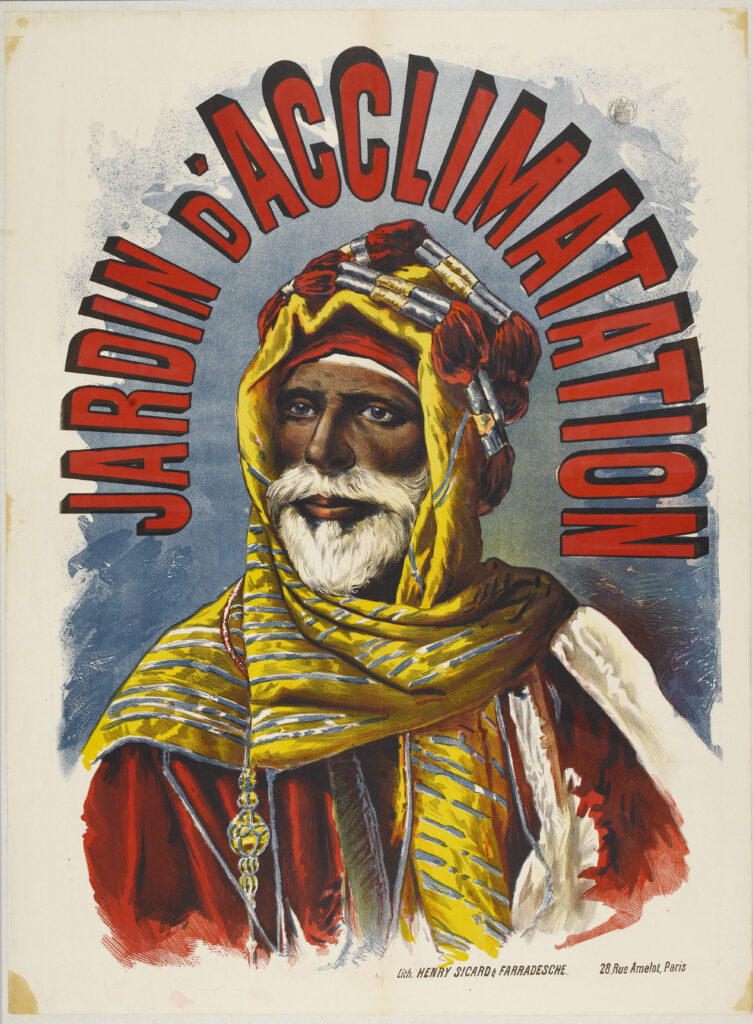
Mivekannin’s answer is not to treat the archive as neutral evidence. According to the museum’s exhibition presentation, he has created thirteen large paintings, four iron sculptures and a ceramic work, most conceived specifically for this installation. The paintings revisit photographs made at ethnographic displays in Paris, including the Champ-de-Mars, the Jardin d’Acclimatation and the Folies Bergère.
Original photographs appear behind two-way glass. That material choice makes looking itself visible: visitors encounter the historical image while also becoming aware of their own position before it. Mivekannin’s paintings heighten that tension. Working with acrylic and mud-based washes on bedsheets, he inserts his own face into scenes whose subjects were once framed as objects of curiosity. The gesture shifts the image away from passive documentation and towards an encounter with agency, memory and responsibility.
The four metal structures extend this argument into the gallery. Made with blacksmiths in Abidjan, they take the form of closed aviaries and refer to successive Paris institutions that housed ethnographic collections: the Trocadéro museum, the west wing of the Palais de Chaillot, the Palais de la Porte Dorée and the Musée du quai Branly itself. Their sequence refuses the comfort of treating colonial display as a completed historical episode.
A museum placed inside its own history
Born in Bouaké in 1986 and descended from the Beninese king Béhanzin, Mivekannin has repeatedly returned to European representations of Black bodies. Here, that practice enters an institution whose collections and architecture are inseparable from the history under examination. The exhibition is curated by Gaëlle Beaujean, with Christine Barthe as scientific adviser, and was developed with Galerie Cécile Fakhoury.
An independent preview by Radio Nova emphasised how the paintings and aviary-like sculptures expose the persistence of colonial visual codes. The show’s strongest proposition may lie in that word “persistence”: the problem is not only what historical photographs depict, but how museums, artists and audiences continue to activate them.
Silent Violence therefore opens as more than an exhibition about a difficult archive. It makes the museum itself part of the work’s field of vision. By turning the gaze back towards the institution and its visitors, Mivekannin asks who is authorised to look, who is made visible, and what ethical obligations begin once the image is seen.
Historical document (not an artwork by Roméo Mivekannin): anonymous lithographic poster for Paris’s Jardin d’Acclimatation, c. 1891, printed by Henry Sicard, Musée Carnavalet – Histoire de Paris, inventory AFF2474. The poster advertises the colonial ethnographic spectacles whose legacy the 2026 exhibition critically examines. It is reproduced here solely as historical evidence, not as an endorsement, and is not confirmed to be on display at the Musée du quai Branly. Image: Paris Musées / Musée Carnavalet, available under CC0 1.0, via Wikimedia Commons. No editorial modification beyond automatic WordPress resizing.
