
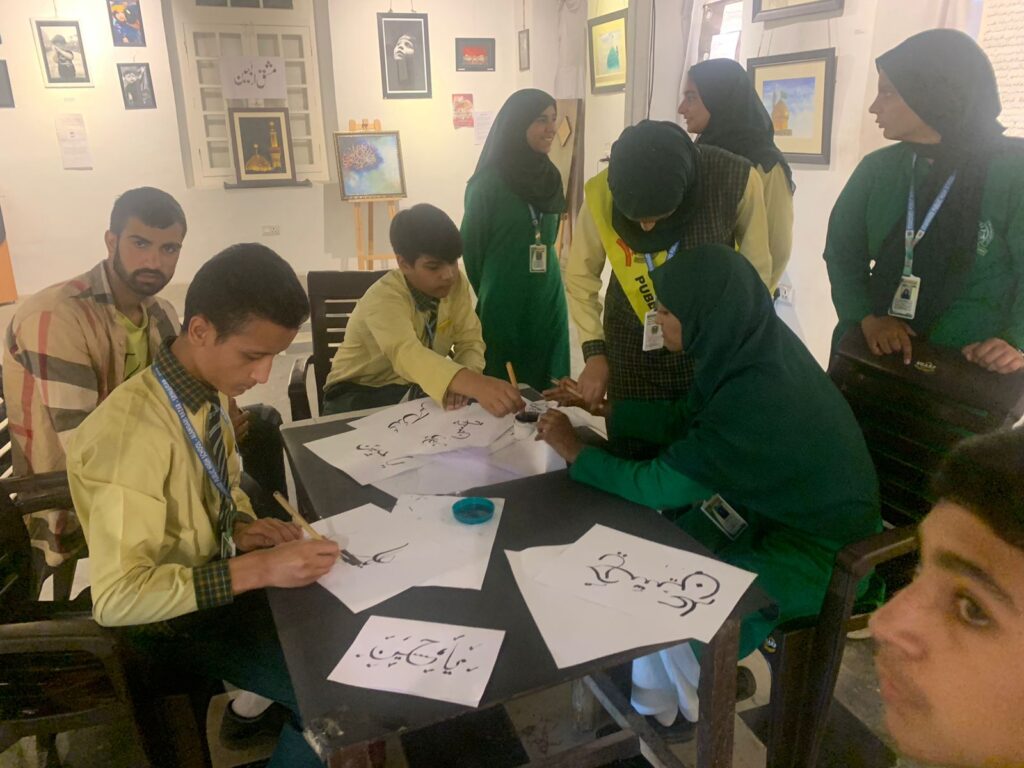

The 2023 exhibition Mashq e Arba’een: Dar’ke Azadari brought calligraphy, visual art and public discussion together around Muharram in Kashmir.
Presented at Mahatta Gallery in Srinagar, the nine-day exhibition explored several dimensions of mourning practice and collective memory.
Mapping spaces of Azadari
The programme included discussion of how Muharram processions, gatherings and commemorative practices occupy physical and social space.
Mapping Azadari meant examining routes, neighbourhoods, architecture and the places through which ritual memory becomes visible.
Calligraphic and visual works approached the same subject through image and written form.
The exhibition allowed artists to respond to religious history without limiting the presentation to devotional objects alone.
An annual platform combining research and expression
The project was organised by Educational Revival through Arts and Aesthetics, known as EdRAAK.
Founder Iliyas Rizvi described the annual exhibition as an expanding programme that added discussions and other events to its regular artistic display.
The available account did not identify individual artists or work titles, but it documented a curatorial structure joining scholarship, ritual and contemporary practice.
Mashq e Arba’een treated Muharram as more than a historical anniversary.
The exhibition examined how mourning is maintained through repeated movement, visual symbols, calligraphy and the organisation of public space.
By presenting these forms inside a gallery, the project created a setting in which religious practice could be studied, interpreted and discussed without being removed from its continuing community significance.