
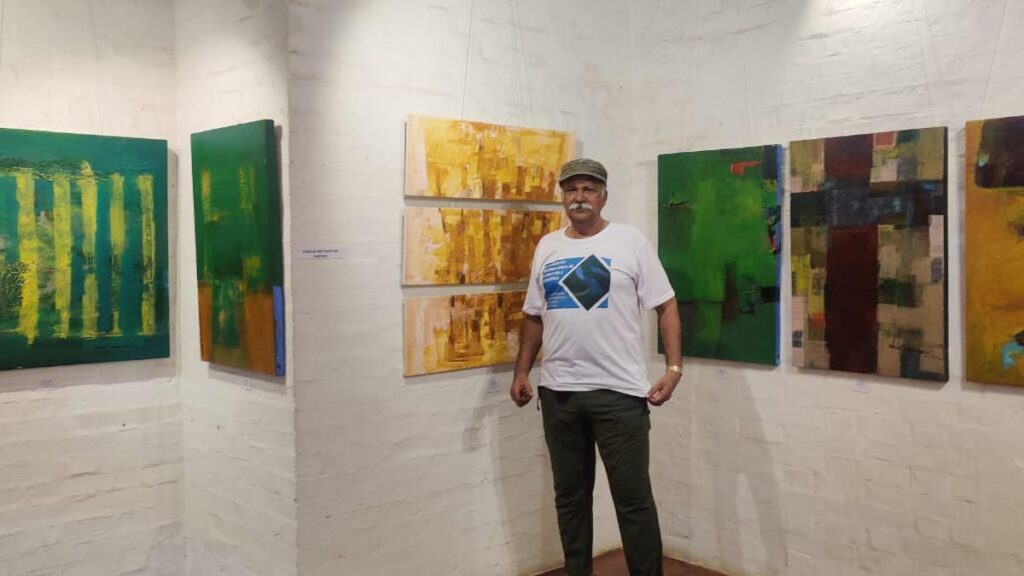



Murali Sivaramakrishnan’s 2023 exhibition Fragments of Earth and Life examined environmental decay through a deliberately non-linear visual narrative.
Presented at DakshinaChitra near Chennai, the exhibition considered the unstable relationship between the earth and the forms of life dependent on it.
Fragments rather than a complete landscape
Sivaramakrishnan avoided presenting nature as a harmonious, untouched whole.
The title described a world experienced through damaged pieces, interrupted systems and partial memories.
Each work occupied the space between earth and life, making environmental degradation visible through material, form and broken continuity.
The exhibition asked viewers to confront ecological damage as an existing reality rather than a distant threat.
An artist moving between literature and visual practice
Sivaramakrishnan’s background included teaching, writing and sustained engagement with environmental thought.
His visual work reflected an interest in how narrative can operate without a conventional beginning, middle and end.
The paintings did not illustrate one environmental event. They accumulated signs of disturbance and asked viewers to build connections across them.
The original account offered limited descriptions of individual works, but clearly identified the exhibition’s central concern.
Fragments of Earth and Life treated the planet as a damaged archive.
Its non-linear structure mirrored the difficulty of understanding environmental collapse, which appears through separate fires, floods, extinctions and altered landscapes while belonging to one connected system.
The exhibition’s value lay in refusing a reassuring view of nature. It used fragmentation to show that ecological beauty and ecological loss now occupy the same visual field.