
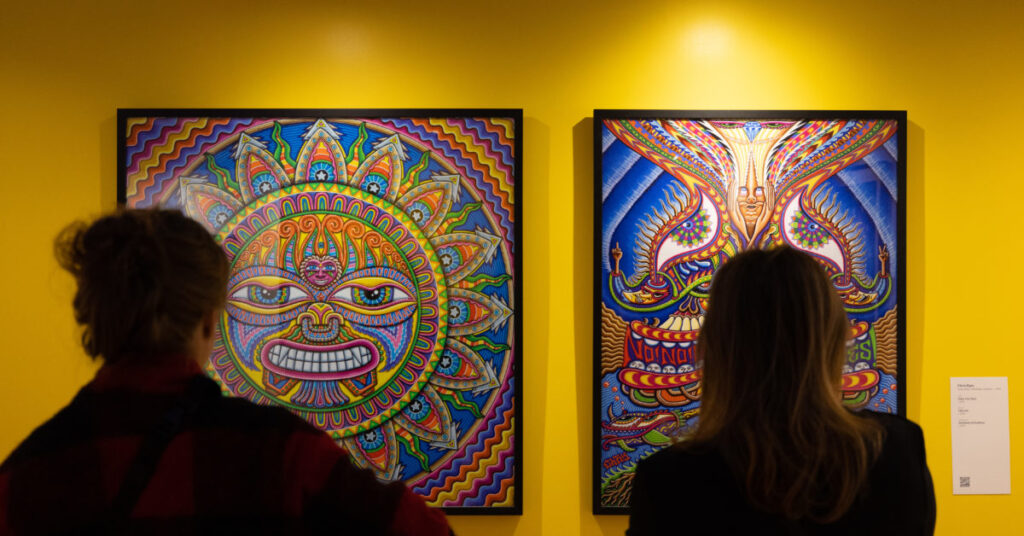
The 2022 exhibition Psychedelics: The Experiential Exhibition transformed Toronto’s Lithuanian House into a two-storey environment exploring hallucinogenic substances through art, history and simulation.
Curated by James Drayton, the project addressed links with music, Indigenous cultures, storytelling and emerging therapeutic research.
Four substances, four constructed environments
The first floor organised its route around peyote and mescaline, psilocybin mushrooms, LSD and ayahuasca.
Clandestinos Art, formed by Bruno Smoky and Shalak Attack, developed the peyote room through their South American cultural connections.
Casey Watson filled the mushroom space with reflective silver forms and mirrors. The LSD room used album covers to trace relationships with psychedelic music.
California artist GMUNK created a seven-metre geometric sculpture activated by projections, laser light, colour and sound to simulate an ayahuasca journey.
Murals and performance extending the experience
Emily May Rose painted a stairwell in which Toronto raccoons discovered mushrooms and entered an increasingly strange forest.
An “acid test” room referred to Ken Kesey’s 1960s events through liquid-light imagery and live performances.
The exhibition did not provide psychoactive substances. It used art and information to simulate aspects of altered perception while presenting changing arguments about controlled therapeutic use.
Psychedelics combined education with spectacle. Its immersive format made cultural history and mental-health claims physically engaging, while also raising questions about whether a commercial exhibition could adequately represent Indigenous knowledge and medically sensitive experiences.