
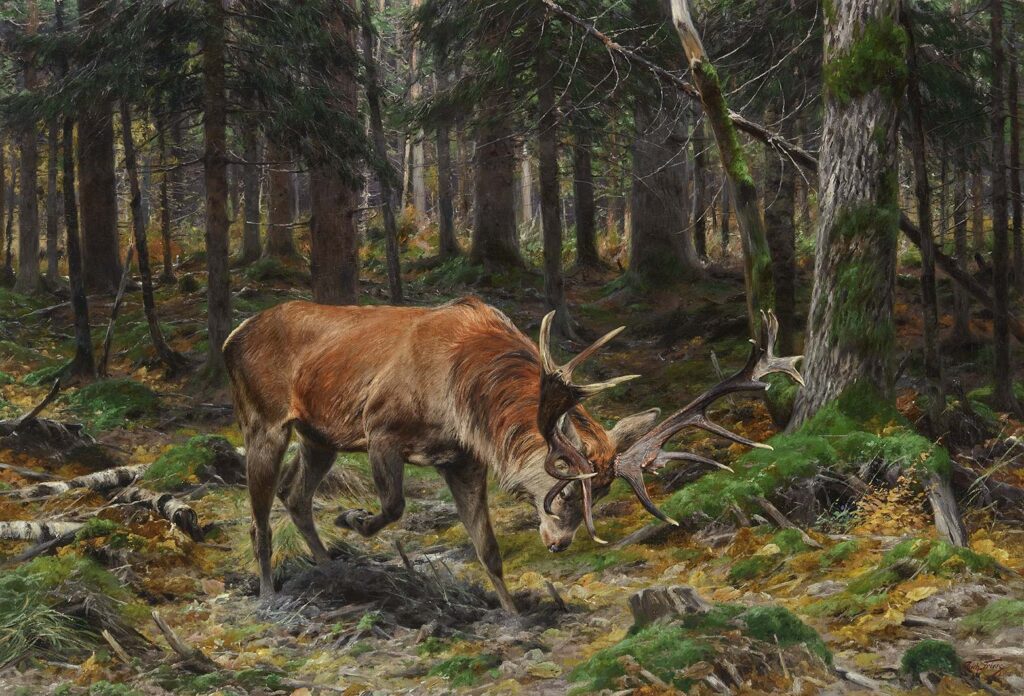



The 2023 exhibition Survival of the Fittest brought 45 wildlife paintings to the National Museum of Wildlife Art in Wyoming.
The exhibition focused on four artists known as the Big Four: Richard Friese, Bruno Liljefors, Wilhelm Kuhnert and Carl Rungius.
Artists entering the field
Working from the late 19th into the 20th century, the four artists travelled to observe animals in their habitats rather than relying only on specimens, earlier images or studio invention.
Their work helped establish a Western visual language for wildlife that emphasised anatomy, struggle, movement and environmental setting.
The exhibition’s title referred to Charles Darwin’s On the Origin of Species and the influence of evolutionary thought on how human-animal relationships were understood.
Masterworks placed within a critical context
The National Museum of Wildlife Art and the Rijksmuseum Twenthe in the Netherlands were identified as the only two museums holding major works by all four artists.
The exhibition drew from both collections and represented the first major scholarly outcome of the museum’s Carl Rungius catalogue raisonné project.
Curator Adam Duncan Harris placed the paintings within histories of colonialism, hunting, conservation and Indigenous knowledge.
This framework allowed the works to be admired for technical achievement while also examining the systems through which European and American artists travelled, collected knowledge and represented land.
The exhibition connected historical wildlife painting with current debates about migration corridors, endangered species, rewilding and large-scale conservation.
Survival of the Fittest therefore resisted a purely nostalgic view of wilderness. It showed how influential images of animals emerged from particular scientific, political and cultural ideas, and how those ideas continue to shape environmental perception.