
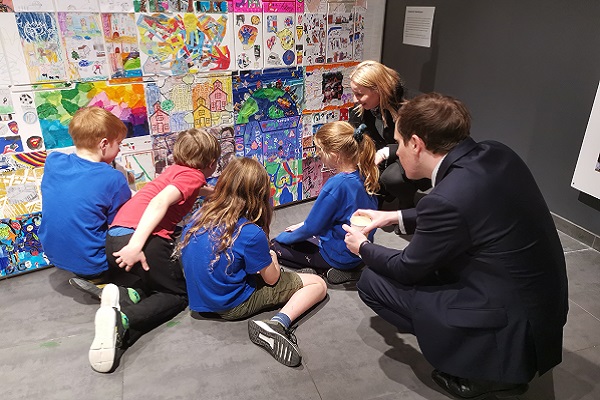
More than 2,000 pupils from 51 Wandsworth schools contributed to a collaborative installation exploring community, belonging and reconnection after the isolation of the pandemic.
The exhibition A Place to Call Home brought together work by pupils in Years 5, 6 and 7 from state and independent schools across the London borough. Led by local artist Alexander Mourant in collaboration with Wandsworth Council’s children’s services and arts service, the project encouraged young participants to consider what it meant to belong to a local community after a prolonged period of distance and disruption.
A collective installation shaped by schools
Each participating class produced an individual artwork panel. Displayed together, the panels formed a larger group installation, while every school retained its own contribution after the public exhibition. The structure allowed the work to function both as a shared statement and as a record of each school’s response.
The project was supported by teaching materials, lesson plans and workshops designed to help pupils express their ideas through visual art. Rather than treating the exhibition as an isolated event, the organisers placed it within a broader effort to strengthen contact between schools and create more opportunities for pupils and teachers to work together.
Art as a starting point for collaboration
The opening was attended by students, teachers, the Mayor of Wandsworth and council representatives. It also marked an early public stage in a partnership intended to connect schools through shared cultural and educational projects.
That wider collaboration included plans for joint visits, careers events, revision support and exchanges of teaching practice. In this context, the exhibition demonstrated how a visual arts project could become a practical instrument for rebuilding relationships between young people and institutions after the pandemic.
A Place to Call Home was therefore more than a display of school art. It documented a collective attempt to restore a sense of place and participation, using individual classroom contributions to construct a single public work.