

An exhibition opening in Detroit on 11 September turns away from the flowers and desert bones that made Georgia O’Keeffe famous, revealing instead how barns, skyscrapers and adobe walls shaped her modernism.
Georgia O’Keeffe: Architecture opened at the Detroit Institute of Arts on Friday with 36 paintings made across almost four decades. It is the first exhibition devoted exclusively to the artist’s engagement with the built environment. The museum now lists the show as currently on view, while a Detroit critic reported from inside the galleries on opening day.
Buildings as biography
The exhibition is arranged around three landscapes that structured O’Keeffe’s life and work: rural architecture, New York City and New Mexico. Rather than following a strict chronology, curator Ben Colman traces how buildings anchored the artist in place, from working barns and farmhouses to Manhattan towers, adobe homes and churches.
Its organizing spark was Stables, painted in 1932 after a road trip through Quebec and the only O’Keeffe painting in the DIA’s own collection. Colman used that spare image to assemble a wider story. The result includes nearly 40 works, among them My Shanty, Lake George, the 1949 Brooklyn Bridge and a reunited group of patio-door paintings.
In the New York section, O’Keeffe’s geometric eye meets a city remaking itself vertically. She painted from high floors of the Shelton Hotel as skyscrapers rose around Midtown, turning steel, smoke and electric light into compressed compositions. The Detroit presentation places those urban pictures beside quieter rural structures, showing continuity between subjects that are usually treated as separate chapters.
A modernism rooted in place
Architecture also complicates the familiar account of O’Keeffe as a painter who escaped the city for the desert. Her buildings are not neutral records. They translate place into blocks of colour, hard edges and charged intervals, making a barn or doorway as psychologically specific as a flower. The exhibition’s regional sequence makes that method legible without flattening it into a single style.
New digital installations recreate the view from the Shelton Hotel and the courtyard of O’Keeffe’s Abiquiú home. The latter space mattered so much that she painted its dark patio door more than 20 times; ten related works appear in the exhibition. The technology is used as context, allowing visitors to compare a physical setting with the artist’s repeated transformations of it.
Opening-day accounts underline the rediscovery at the centre of the show. Wallpaper* described the exhibition as a first-of-its-kind survey, while Detroit publication Midbrow noted how its buildings redirect attention from O’Keeffe’s most reproduced motifs toward her sustained fascination with ordinary structures. An earlier Guardian feature similarly connected the work to her relationships with architects and designers.
Running until 3 January 2027, Georgia O’Keeffe: Architecture offers more than an unfamiliar slice of a famous career. It asks viewers to see modernism as a practice of looking closely at inhabited space—and makes Detroit, a city whose own identity is inseparable from architecture and industry, an especially resonant place for that reconsideration.
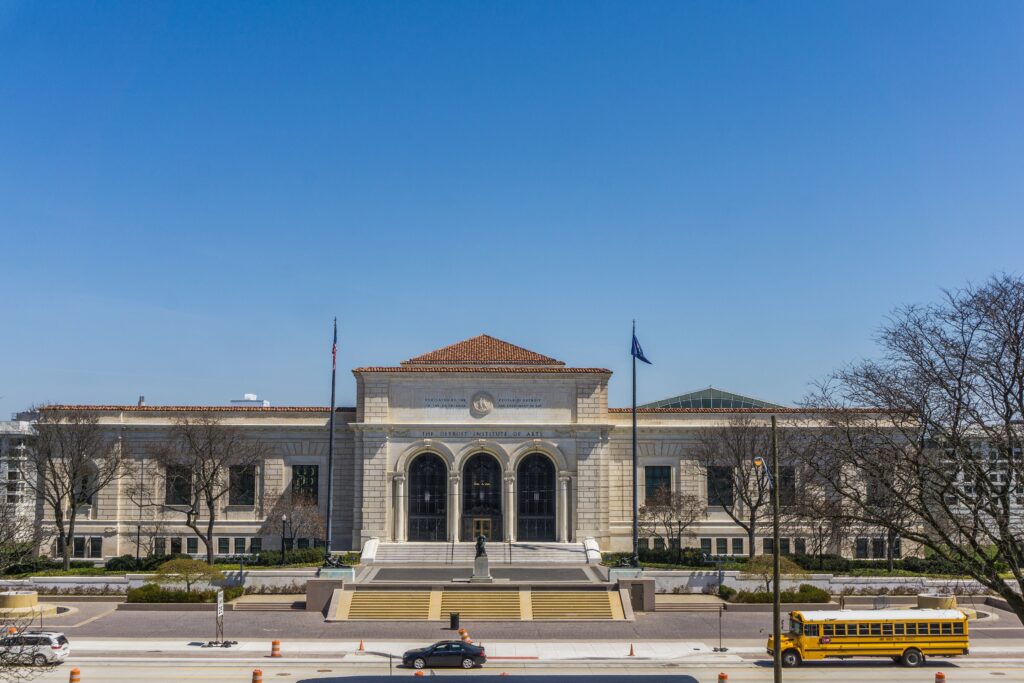
Featured image: Detroit Institute of Arts seen from the Detroit Public Library, 2016. Contextual image; not a view of Georgia O’Keeffe: Architecture. Photo: Av9, CC BY-SA 4.0, via Wikimedia Commons.
