
On Monday, October 26, the Museo Nacional del Prado presented La ingeniería en el Prado: un puente entre el arte y la técnica, a new route through 29 works in its permanent collection. From bridges and roads to ports, mills and fortifications, the project asks visitors to treat painted infrastructure as evidence rather than scenery.
The route spans works from the 15th to the 19th century by artists including El Greco, Goya, Raphael, Antonio Joli and Mariano Ramón Sánchez. Created with Fundación FHECOR, it proposes a meeting between two habits of looking that museums often keep apart: the artist’s choices and the engineer’s attention to how things stand, move and endure.
When paintings become engineering records
The selection is organized in three groups. In some paintings, infrastructure is the principal subject. Elsewhere it provides the setting for a narrative. In a final group, it survives as a detail so small that finding it becomes an exercise in patient looking. That structure turns familiar pictures into working documents of landscapes altered by construction.
Two views by Mariano Ramón Sánchez make the historical value especially clear. His paintings preserve the appearance of the bridge at Molins de Rei, demolished in 1971, and the Pont del Diable at Martorell, later rebuilt after being blown up during the Spanish Civil War. Their arches are both compositional devices and records of structures exposed to political and physical change.
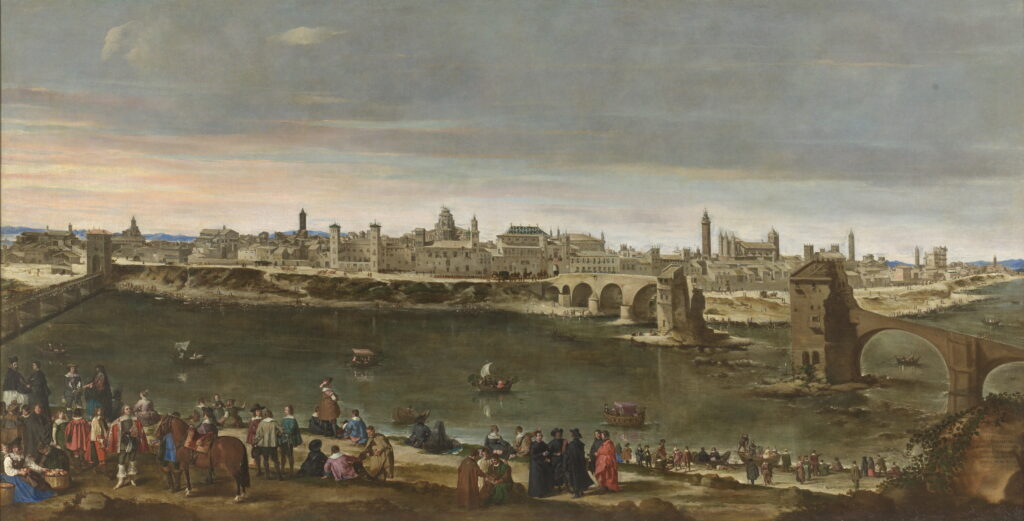
Juan Bautista Martínez del Mazo’s View of Zaragoza in 1647 offers another kind of testimony. Its broad cityscape includes the stone bridge over the Ebro, allowing the painting to register an infrastructure damaged by flooding and transformed over time. The picture’s usefulness is not accidental to its beauty; the route argues that each quality sharpens the other.
Other works move from the local to the global. Antonio Joli’s views of Naples record docks, fortifications and harbour construction around the departure of Charles of Bourbon for Spain. In Goya’s The Meadow of San Isidro, bridges sit deeper in the landscape, helping to locate a social scene whose engineering might otherwise remain invisible.
A museum route built around closer looking
Independent reports published after Monday’s presentation confirm that the route is not a conventional temporary exhibition. The paintings remain distributed through the Villanueva Building, and visitors follow a thematic path across the permanent collection. It is an economical intervention: no new spectacle is required, only a new question brought to existing works.
Curators Francisco Javier Fernández Pozuelo and Francisco Javier León González use that question to connect technical literacy with art history. A bridge can anchor perspective, indicate trade, commemorate power or quietly date a view. Reading it closely also reveals the labour and knowledge that made the surrounding world possible.
This focus resists the idea that technology belongs outside culture. Engineering enters these paintings through daily life, ceremony, disaster and reconstruction. The result is less a catalogue of inventions than a history of how societies imagine and reshape their environments.
La ingeniería en el Prado remains on view in Madrid until February 21, 2027. Its strongest invitation is simple: look beyond the declared subject. A road behind a saint, a port beneath a royal departure or a bridge at the edge of a meadow may hold another history in plain sight.
Image: Juan Bautista Martínez del Mazo, View of Zaragoza in 1647, 1647, Museo Nacional del Prado. This exact work is included in the 2026 route; the image represents the painting, not the October 26 presentation. Faithful reproduction from the Museo Nacional del Prado via Wikimedia Commons, Public Domain Mark 1.0. No editorial modification.
