
On Sunday, October 25, the Museum of Fine Arts, Houston opened American Modernism from the Charles Butt Collection to the public in its Audrey Jones Beck Building. The Houston presentation brings together 93 paintings, works on paper and prints, expanding a touring exhibition that has already appeared in Fort Worth and Austin.
The show turns a private collection into a public argument about how modern American art was made. Butt, the Texas philanthropist and longtime H-E-B chairman, began collecting after encountering Winslow Homer as a student. His holdings now move from late-19th-century watercolor to postwar abstraction, while giving unusual weight to the coast, the built environment and artists connected to Texas.
The collection’s earliest anchor is Homer’s 1885 watercolor Along the Road, Bahamas. Its attention to weather, movement and a Caribbean subject introduces a recurring tension in the galleries: familiar national narratives are repeatedly widened by travel, migration and regional experience.
A collection shaped by place
The exhibition is arranged in five thematic sections rather than as a strict timeline. “Intimate Perspectives” brings Edward Hopper, Georgia O’Keeffe and Marsden Hartley into conversation through portraits, interiors and compressed landscapes. “The Language of the Sea” follows an enduring motif in American art and in Butt’s own biography, from Maurice Prendergast’s Venetian festival to Thomas Moran’s ominous Smoking Ships at Sea.
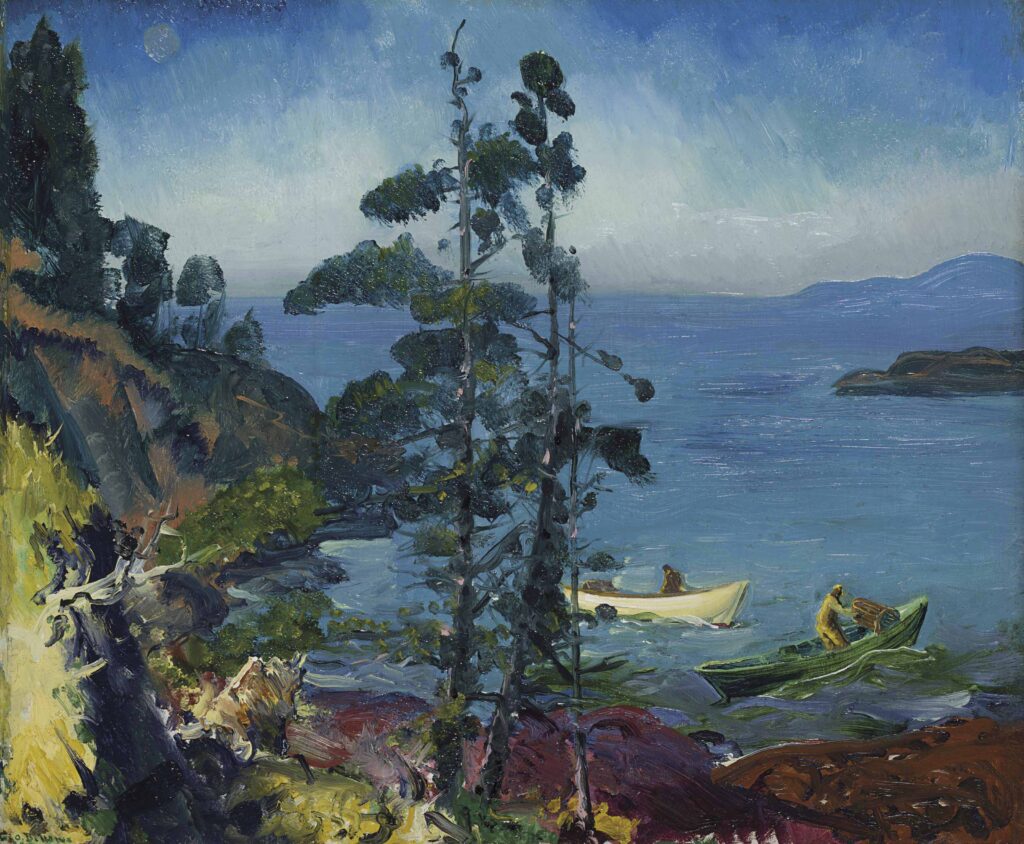
A third section, “The American Scene,” treats landscape as something more unstable than national scenery. John Marin’s views of Weehawken, New Jersey, appear in depth, alongside work by Arthur Dove, George Bellows and Thomas Hart Benton. Seven Charles Burchfield watercolors form a Houston-specific focus, reinforcing the artist’s ability to make weather and vegetation feel psychologically charged.
The independent Houston Chronicle preview, based on a visit to the installed galleries on October 22, notes that the local edition contains roughly ten more works than earlier stops. Among them are additions by Jasper Johns, whose monoprint and lithographs close the exhibition’s final section.
Modernism without a single center
“Painting in the Machine Age” places factories, farms and urban structures beside geometric abstraction. Works by Jacob Lawrence, Stuart Davis and Charles Sheeler sit with Blanche Lazzell and Alice Trumbull Mason, linking industrial America to experiments in form. The final section, “New Directions,” extends that conversation through Ellsworth Kelly, Mark Rothko and Alma Thomas.
That breadth matters. The exhibition’s title risks suggesting a settled canon, yet its strongest idea is movement: between coast and city, figuration and abstraction, private taste and public history. Mexican artist Rufino Tamayo appears beside predominantly United States-born peers, while Texas figures Mary Bonner and Everett Gee Jackson complicate the usual East Coast map of modernism.
Organized by the Amon Carter Museum of American Art, the exhibition remains on view at the MFAH through January 18, 2027. Its Houston chapter does not resolve what counts as “American” modernism. Instead, it lets 93 works test the boundaries of that phrase in public.
Image: George Bellows, Evening Blue (Tending the Lobster Traps, Early Morning), 1916, oil on panel, Collection of Charles Butt. This work is documented in the exhibition by its organising museum; the image depicts the painting, not the 2026 Houston installation. Wikimedia Commons, Public Domain Mark 1.0. Faithful reproduction of a public-domain painting; no editorial modification beyond automatic WordPress resizing.
