

After four years behind construction fences, the Hirshhorn Sculpture Garden reopened on Washington’s National Mall on 31 October, turning a difficult sunken site into a more accessible conversation between modern sculpture, contemporary commissions and landscape.
The public returned on Saturday to 1.3 acres redesigned by Japanese artist and architect Hiroshi Sugimoto. The museum’s current exhibition page records that the garden opened to the public, while its opening programme brought artists’ talks and hands-on activities into the renewed grounds. The event completed the Hirshhorn’s largest campus transformation since the museum opened in 1974.
A garden reopened to the city
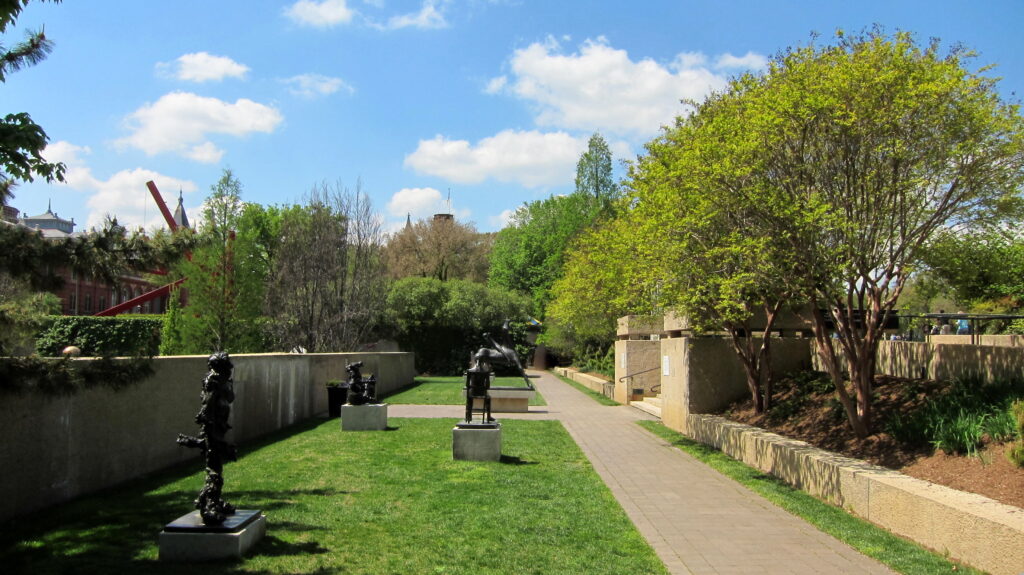
Access is the redesign’s clearest civic argument. Five entrances replace two, including a restored 60-foot-wide approach from the National Mall. A long-closed underground passage again links the museum building and garden, now lined with Sugimoto’s reflective Passage of Reflectance. Accessible ramps, new overlooks and expanded seating make the sunken site easier to enter, cross and inhabit.
The physical changes are substantial but deliberately quiet. Hand-hewn walls made from 950 tons of stone divide the landscape into outdoor galleries, while almost 30,000 new trees and plants soften its edges. A reflecting pool can be drained to create a stage, giving performances and education a place within a garden previously organised mainly for looking.
The redesign was not uncontested. Preservationists questioned earlier plans for altering a landmark landscape, and the final scheme emerged after public review. That debate gives the reopening added weight: the project had to balance Gordon Bunshaft’s original 1974 composition, Lester Collins’s greener 1981 intervention and the needs of a contemporary museum.
Modern foundations, contemporary pressure
Nearly 60 works now occupy the garden and plaza, up from about 35 before the project. The new arrangement returns foundational sculpture to view, including Rodin’s The Burghers of Calais, Matisse’s four Backs, and bronzes by Barbara Hepworth and Henry Moore. Thirty-nine works come from Joseph H. Hirshhorn’s original gift, and 21 were part of the 1974 installation.
That historical spine is tested by recent acquisitions and commissions. Elmgreen & Dragset’s Eight turns the familiar outline of a swimming pool upright at the North Overlook. The West Lawn opens with Yoshitomo Nara’s Sentinels of Stillness, a group of three monumental figures, while works by Raven Halfmoon, Lauren Halsey and Liz Larner extend the garden’s account beyond its Modernist foundations.
Early visits described a landscape of stone, bronze, water and shade rather than a conventional sculpture park. That distinction matters. Sugimoto has not simply increased capacity; he has made circulation part of the curatorial experience. Visitors encounter art from the Mall, from overlooks and through the restored passage before reaching any single object.
The reopening therefore changes the Hirshhorn’s relationship with the city as much as its display space. The redesigned garden preserves the institution’s historic collection while creating room for performance, temporary commissions and informal use. Its success will depend on whether those expanded points of entry remain genuinely public, but the opening makes access—not monumentality—the project’s central claim.
Featured image: Historical view of the Hirshhorn Sculpture Garden in 2010, before the 2022–2026 transformation. Photograph by AgnosticPreachersKid, via Wikimedia Commons, licensed under CC BY-SA 3.0. It does not show the reopened garden or the 31 October 2026 event. No editorial modifications; WordPress generated a resized derivative.
