


London gained a new cultural address on 3 November when the Zaha Hadid Foundation opened the architect’s former Clerkenwell headquarters to the public. Its inaugural exhibition, Zaha Hadid: Architecture of Performance, shifts attention away from Hadid’s celebrated buildings to a more elusive strand of her practice: the spaces she made for bodies, music and spectacle.
Installed at 10 Bowling Green Lane, the show follows twenty-five years of experiments across dance, pop touring and opera. Archival drawings, models, digital renders, costume designs, photographs and film assemble five projects that treated performance as a testing ground for architectural ideas. The Foundation presents this work not as a sideline, but as a medium through which Hadid’s thinking became physical. The exhibition runs to 27 March 2027 and is free to enter.
When architecture becomes choreography
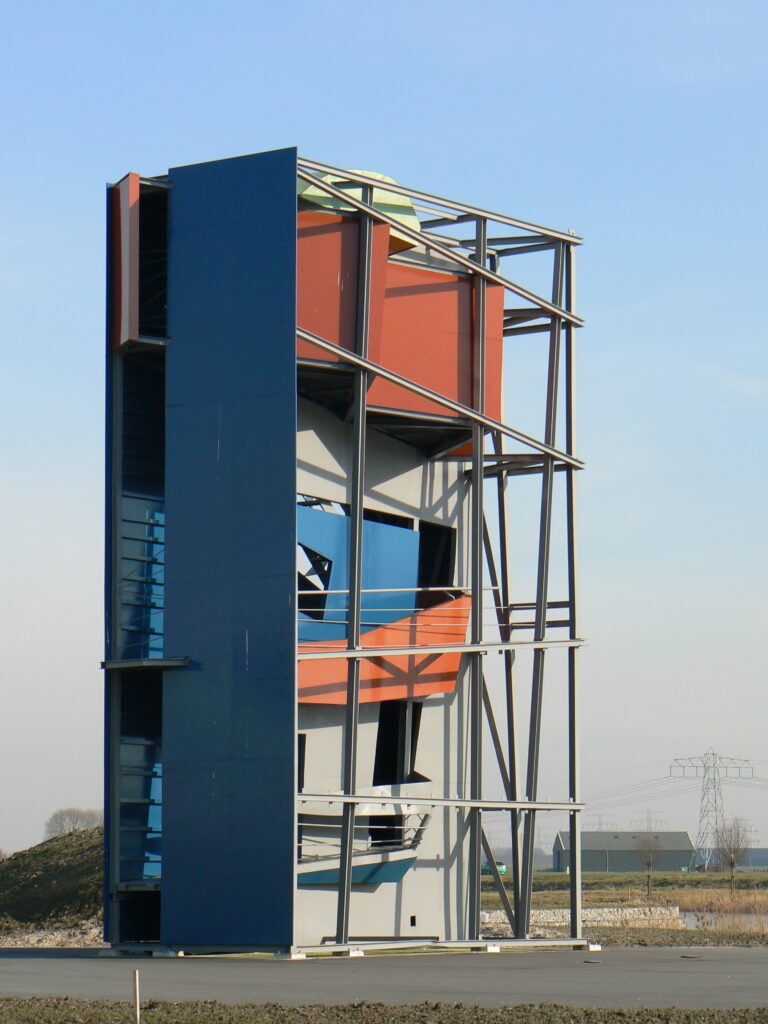
The earliest case is d1. (1989), created with choreographer Rosemary Butcher, in which dancers moved across a drawn floor and turned a site plan into a score. Hadid’s Music Video Pavilion of 1990 then explored spectatorship and the framing of vision at a moment when she had yet to complete a permanent building.
A decade later, architecture itself appeared to perform. For the Pet Shop Boys’ Nightlife world tour and Frédéric Flamand’s Metapolis ballet, both developed in 1999–2000, static scenery gave way to changing multimedia environments. The sequence culminates in Così fan tutte, staged for the Los Angeles Philharmonic in 2014, where Hadid’s curved forms met Hussein Chalayan’s transformable costumes.
Together, these projects make movement a design instrument. They also place Hadid within a wider history that runs from the spatial experiments of the twentieth-century avant-garde to the office’s transition from analogue drawing to digital production. The collaborations show an architect testing how an audience sees, moves and gathers long before those questions became familiar features of immersive exhibition design.
An archive opens to the city
The exhibition also marks a change in the life of the building that housed Hadid’s practice for more than three decades. The Victorian schoolhouse has been refurbished by Studio KA as a public cultural space, retaining traces of both its original fabric and Hadid’s occupation, including angular floor inserts and Z-shaped door handles. The London Society reported on opening day that the reuse adds a rare public destination to Clerkenwell while keeping the building’s layered history visible.
The Foundation’s opening programme extends beyond the gallery. LionHeart’s film commission The Rebar Beneath and an animated timeline by Mona Chalabi introduce other routes into Hadid’s legacy, while planned talks, workshops and research activity promise to bring the archive into conversation with contemporary practice.
Opening the former studio gives the exhibition an unusual charge: visitors encounter performance projects inside a place where architectural work was itself produced. Rather than fixing Hadid’s legacy in a conventional monument, the Foundation presents it as an active field—one where drawings become stages, buildings become performers and an archive becomes part of the city’s cultural life.
Image: Zaha Hadid’s Video Pavilion in Appingedam, designed in 1990 and photographed after its 2008 reconstruction. The project appears in the 2026 exhibition; this photograph does not show the London installation or opening. Photograph by Gerardus, released into the public domain via Wikimedia Commons. No editorial modification beyond WordPress resizing.
