
Hartford’s Wadsworth Atheneum opened The Sense of Beauty: Six Centuries of Painting from Museo de Arte de Ponce on 5 November, bringing 60 works from one of the Caribbean’s most significant art collections into a new institutional setting. The exhibition, on view through 14 March 2027, ranges from Renaissance and Baroque painting to modern and contemporary Puerto Rican art.
The opening formed part of the museum’s First Thursdays programme, pairing the galleries with Latin jazz, Puerto Rican food and a screening of El Cantante. That public celebration gave the exhibition an appropriately social frame: this is not simply a procession of canonical pictures, but an account of how a collection built in Puerto Rico can generate new conversations when it travels.
A collection on the move
Organised by the Museo de Arte de Ponce with the Wadsworth, the exhibition extends a tour created while the museum’s Edward Durell Stone building is repaired following the earthquakes that struck Puerto Rico in 2020. Keeping the collection visible during that interruption turns necessity into a form of cultural exchange.
The Wadsworth presentation is divided into five thematic sections. European paintings by El Greco, Peter Paul Rubens, Francisco de Goya and Élisabeth Louise Vigée Le Brun appear beside American landscapes by Frederic Edwin Church and works associated with British Victorian painting. Many are being shown on the US mainland for the first time.
Yet the exhibition’s reach depends on more than celebrated European names. Paintings by Puerto Rican artists including José Campeche, Francisco Oller y Cestero, Myrna Báez, Rafael Ferrer and Waldemar Morales Lugo trace changing ideas of portraiture, landscape and national identity from the eighteenth century onward. Their presence resists treating the collection as a distant anthology of European taste.
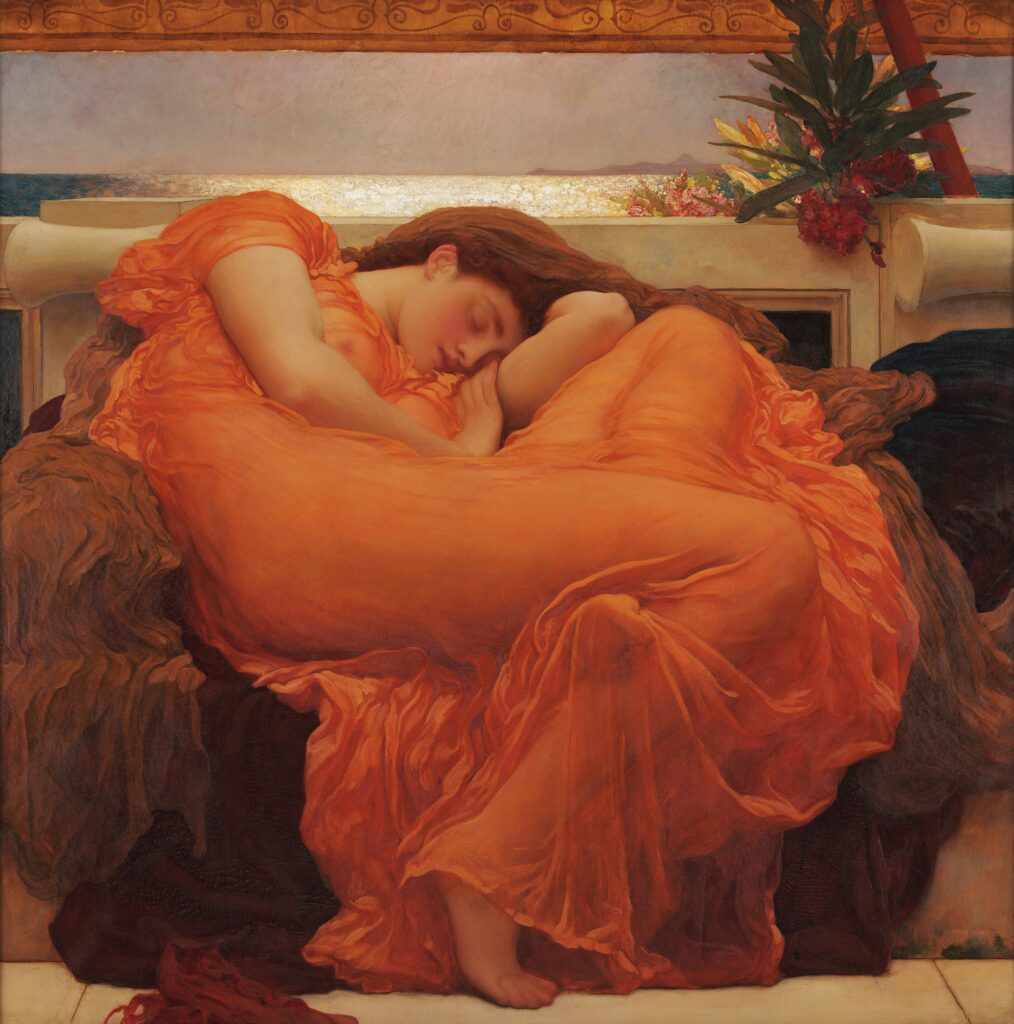
Frederic Leighton’s Flaming June, painted around 1895, is the exhibition’s most instantly recognisable image. The sleeping figure wrapped in incandescent orange fabric has travelled widely, but it remains inseparable from the Museo de Arte de Ponce, which acquired the work in the 1960s. In Hartford, its visual familiarity becomes an entry point into the lesser-known history of the institution that preserved it.
Beauty as a shared history
The exhibition’s title asks viewers to consider beauty not as a fixed hierarchy but as something shaped by collecting, displacement and encounter. That argument gains weight in Hartford, where the Wadsworth is also presenting ¡Batey Boricua! Creamos Nuestro Espacio | We Create Our Space, a companion exhibition focused on contemporary Puerto Rican artists in Connecticut.
Together, the two projects connect a historic collection formed on the island with a living diaspora in New England. The result is a broader cultural map: paintings made across six centuries meet the circumstances of migration, earthquake recovery and institutional stewardship that determine where art can be seen.
For the Museo de Arte de Ponce, the tour keeps its holdings accessible while its home is repaired. For the Wadsworth, it creates an opportunity to look beyond familiar art-historical categories and towards the routes through which collections acquire meaning. The opening in Hartford therefore marks more than another stop on an itinerary; it makes mobility itself part of the exhibition’s story.
Image: Frederic Leighton, Flaming June, 1895, oil on canvas, Museo de Arte de Ponce, The Luis A. Ferré Foundation, Inc. Faithful reproduction via Wikimedia Commons; Public Domain Mark 1.0.
