
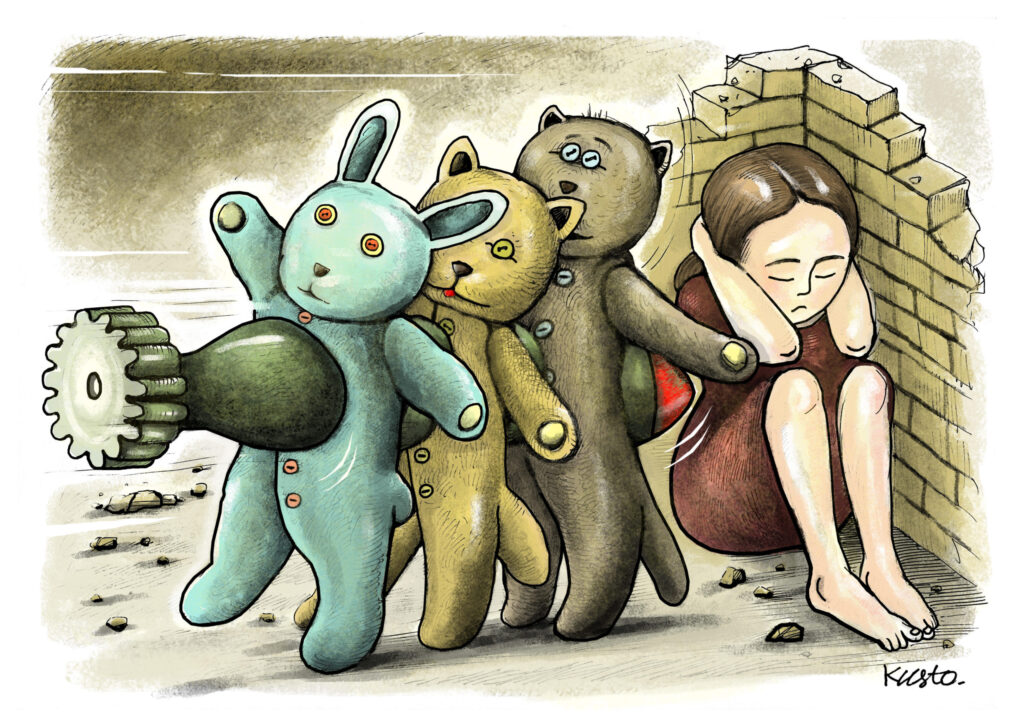

The Museum of Russian Art in Minneapolis opened Say No to War: Political Cartoons by Ukrainian and Russian Artists on 20 April 2022 as an immediate visual response to Russia’s invasion of Ukraine.
Organised with political cartoonist Andrey Feldshteyn, the exhibition brought together recent work by artists who used satire, symbolism and compressed narrative to condemn violence and express solidarity with Ukraine.
Cartoons produced in response to war
The participating artists included Victor Holub, Valery Momot and Oleg Goutsol from Ukraine, Yuriy Pogorelov from Ukraine and the United States, and Russian artist Viacheslav Shilov, alongside other contributors.
The works were displayed in the museum’s Mezzanine Gallery. Their directness reflected the speed with which political cartoons can respond to events, turning complex military and political realities into images designed to be understood almost instantly.
Curator Masha Zavialova described the selection as an emotional and immediate reaction to a war initiated by Vladimir Putin’s regime. She characterised the cartoons as simultaneously sad, frightening, humorous and intelligent, since their impact depended on the viewer recognising both the visual argument and the emotion behind it.
A Russian-art institution taking a public position
The exhibition was especially significant because it took place at a museum devoted to Russian art and cultural history. By presenting Ukrainian and Russian artists together in explicit opposition to the invasion, the institution distinguished cultural heritage from state violence.
Political cartoons often rely on exaggeration, irony and recognisable symbols. In this exhibition, those methods allowed artists to address destruction, authoritarian power and resistance without requiring lengthy explanation.
The museum stated that the display would remain open for as long as the war continued. That decision made the exhibition more than a short commemorative event. It became an ongoing public statement, using the museum’s space to preserve immediate artistic testimony and to demonstrate that Russian cultural identity could not be treated as synonymous with support for the invasion.