
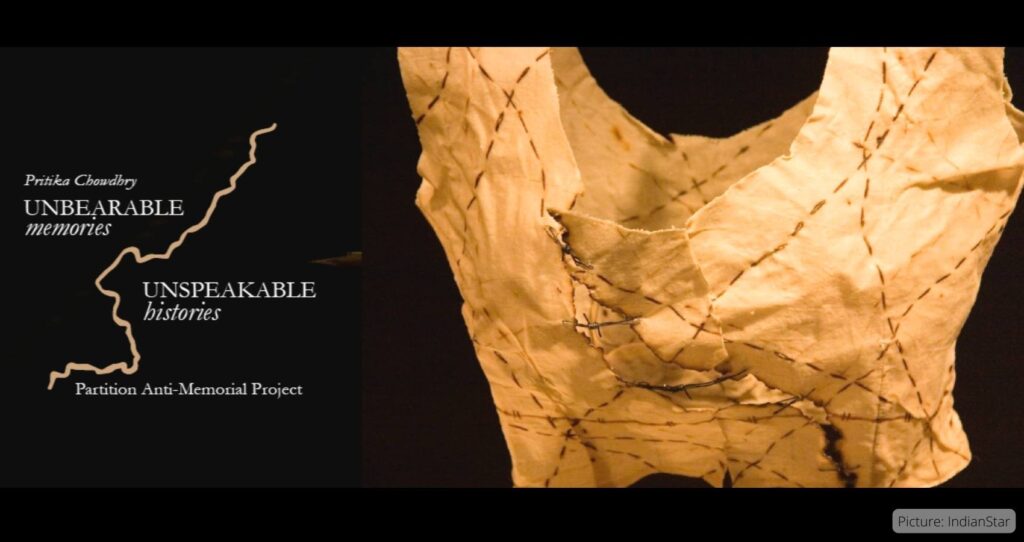
Pritika Chowdhry’s 2022 retrospective Unbearable Memories, Unspeakable Histories examined the continuing trauma of the 1947 Partition of India through sculpture and temporary anti-memorials.
Presented at the South Asia Institute in Chicago, the exhibition marked the 75th anniversary of the division that created India and Pakistan and led eventually to the formation of Bangladesh in 1971.
Memory outside official monuments
Partition displaced more than 20 million people and caused extensive communal violence. Chowdhry’s project focused on stories and forms of knowledge that had been excluded from dominant national narratives.
She began the Partition Anti-Memorial Project in 2007. Over 15 years, it developed into ten bodies of work examining Partition and the Bangladesh Liberation War through a diasporic and postcolonial perspective.
Unlike permanent monuments that stabilise an official account, the installations were temporary, experiential and open to counter-memory. Their materials evoked bodies, absence, violence and the difficulty of memorialising events that continued to shape family and political life.
Gendered histories and global consequences
Chowdhry placed particular emphasis on historically marginalised female voices. Her work also connected South Asian Partition with wider patterns of colonial division, border violence, war, genocide and displacement.
The artist’s practice joined research with large-scale sculpture and site-sensitive installation. The works created space for mourning while resisting simplified narratives of national independence.
Unbearable Memories, Unspeakable Histories treated Partition not as a closed event in 1947 but as a structure whose effects remained visible across generations, borders and diasporic identity.