
On September 19, the 18th Lyon Biennale opened across the French city under the title To pass from one dream to another. Bringing together 120 artists from 42 countries, the exhibition moves through eleven sites, from former railway workshops to museums, a metro station and the hidden passageways that give the project its central image.
Guest curator Catherine Nichols takes Lyon’s traboules—routes that cut through courtyards and buildings—as a model for shifting between perceptions and collective futures. The official curatorial statement begins with the city’s history of commerce and industry, then widens “economy” beyond money to include attention, care, relationships and imagination.
An economy beyond money
Nichols frames the project through Walter Benjamin’s critique of capitalism as a collective dream and Robert Filliou’s experiments in poetic economy. The result is not a single argument but a network of different pressures. Industrial systems anchor the Grandes Locos, an immense former SNCF maintenance complex; relational economies shape the Musée des Tissus et des Arts décoratifs; existential questions gather at macLYON.
A review published by Le Monde on opening day finds the connection to that theme deliberately uneven. At the former textile museum, Lucia Kagramanyan’s embroidered hammock forms carry Armenian lullabies and historical memory, while Kokou Ferdinand Makouvia turns terracotta, rope and copper into a precarious environment. At the Institut d’art contemporain, Yehwan Song links threatened water systems with overflowing digital flows; Maja Fredin compares factory farming with the remaking of human bodies.
That range protects the Biennale from becoming a diagram. Some works address production, circulation or value directly; others use the theme as a loose passage into questions of colonialism, ecology, labor and bodily discipline. The friction is part of the experience: visitors must decide where an economy begins and what forms of exchange art can make visible.
A city becomes the exhibition
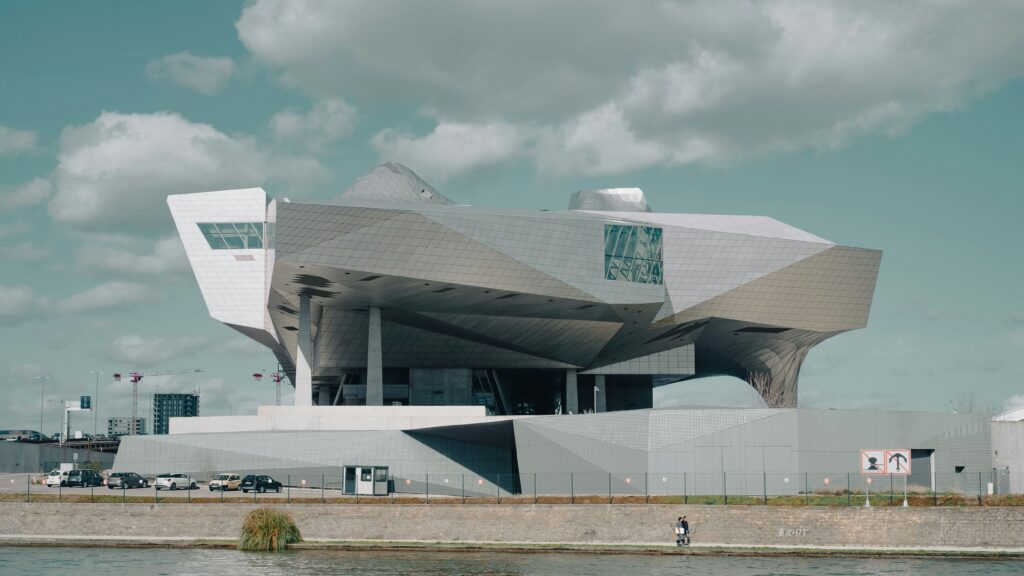
The urban spread matters as much as the artist list. The main route connects the Grandes Locos, the Musée des Tissus, macLYON and the Institut d’art contemporain, while projects extend into the Musée des Confluences, Croix-Rousse traboules and civic infrastructure. Moving between them turns Lyon’s industrial inheritance and present-day cultural geography into part of the work.
The scale is substantial, but its timing also exposes institutional vulnerability. Le Monde reports an €8 million budget and notes that funding secured only in late August allowed 45 additional artists to be confirmed. An exhibition about value therefore opens with its own conditions of production visible: ambition, public space, private support and financial constraint occupy the same map.
The Lyon Biennale continues through December 13, 2026. Its opening weekend includes exhibitions and public programs at macLYON, while the wider route asks audiences to cross the city as they cross between competing ideas of how collective life might be organized.
Image credit: Musée des Confluences in Lyon, one of the venues of the 18th Lyon Biennale. This is a contextual photograph of the building, not a view of the 2026 exhibition. Photograph by Ennio Berti via Unsplash, used under the Unsplash License.