
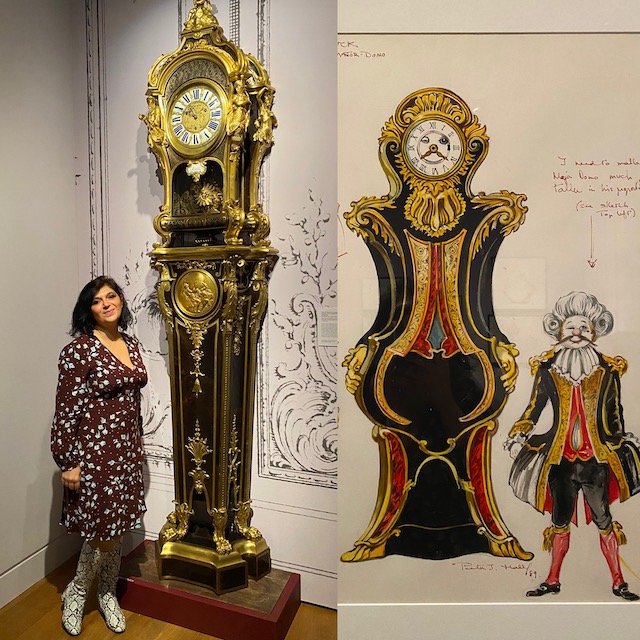


An exhibition at London’s Wallace Collection examined how 18th-century French decorative arts helped shape the visual language of Walt Disney animation.
Presented in collaboration with New York’s Metropolitan Museum of Art, Inspiring Walt Disney: The Animation of French Decorative Arts placed 20th-century animation drawings beside furniture, porcelain and painting from the French Rococo period. The exhibition ran from 6 April to 16 October 2022.
Two centuries of animated objects
The exhibition focused on a shared ambition across different media: giving personality, movement and emotional force to inanimate forms. Disney artists transformed clocks, candlesticks, teapots and furniture into characters, while 18th-century craftsmen had already endowed decorative objects with elaborate curves, gestures and theatrical presence.
More than 120 production drawings and works on paper from the Walt Disney Animation Research Library and the Walt Disney Archives were shown alongside around 30 historic objects. Their juxtaposition revealed how animators studied the humour, elegance and visual invention of French decorative art.
From Fragonard to animated film
Jean-Honoré Fragonard’s The Swing, painted around 1767, was among the key works. Its composition, movement and atmosphere provided a reference point for several Disney productions, including Beauty and the Beast, Tangled and Frozen.
The exhibition also drew attention to the labour behind animation. Sequences of preparatory drawings showed how characters and transformations were constructed frame by frame, including the celebrated scene in which Cinderella’s appearance changes through movement, light and costume.
By placing animation beside decorative art rather than treating it as a separate popular form, Inspiring Walt Disney argued for a continuous history of visual storytelling. The exhibition showed that Disney’s imagined worlds were not created in isolation but developed through close attention to older artistic traditions, especially the theatricality and wit of 18th-century France.