
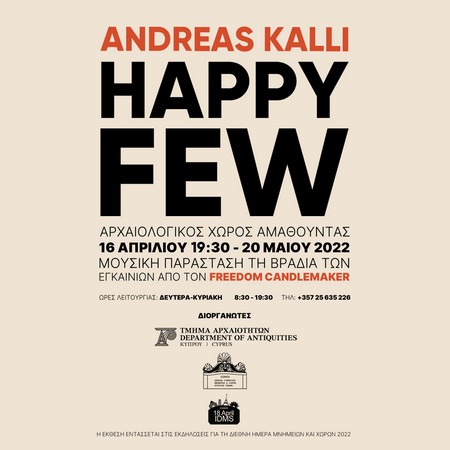
Cypriot artist Andreas Kalli used the archaeological site of Amathous as the setting for a sculptural installation examining memory, time and the relationship between human creation and the environment.
Titled Happy Few, the exhibition opened on 16 April 2022 as part of events marking the International Day for Monuments and Sites. It was organised by the Department of Antiquities in collaboration with ICOMOS Cyprus and curated by Niki Papaspyrou and Yiannis Violaris.
Contemporary forms among ancient remains
Kalli worked with natural material, using bush forms to evoke and reinterpret the columns of the archaeological site. The installation did not attempt to reproduce antiquity. Instead, it translated architectural traces into a contemporary sculptural language and placed them in direct dialogue with the surrounding ruins.
The work addressed evolution, consciousness, collective memory and the marks left by human activity. By situating the installation in a public archaeological space, the exhibition invited viewers to consider how ancient structures continue to shape present-day ideas of identity, culture and environment.
A dialogue across time
The encounter between contemporary art and antiquity was central to the project. The installation asked visitors to look at Amathous not only as a preserved historical site but as an active setting in which new meanings could be produced.
Music formed part of the opening, with Freedom Candlemaker presenting compositions developed from the ideas behind Kalli’s installation. A bilingual catalogue in Greek and English accompanied the exhibition.
Born in Larnaca in 1987, Kalli studied at the Athens School of Fine Arts and attended Central Saint Martins in London. Before Happy Few, he had presented solo exhibitions in Cyprus and represented the country at the Biennale of Young Artists in Milan.
The exhibition remained at Amathous until 20 May 2022. Its placement within the archaeological landscape gave the work its particular force, turning the site itself into part of the sculptural argument.