

On 24 October 2026, the Victoria and Albert Museum opened Freddie Mercury | Splendid Things, a free trail that threads eight costumes through six galleries at its South Kensington building. Marking the singer’s 80th anniversary year, the display treats stage clothing not as celebrity memorabilia but as part of an artistic language built for cameras, concert halls and stadium crowds.
Developed with Mary Austin, Mercury’s former fiancée and lifelong friend, the trail brings seven loans from her collection together with one look already held by the museum. The V&A describes the project as a journey across an iconic career, from early Queen performances to Mercury’s final years.
Eight looks, six museum settings
The sequence begins with the monochrome outfit worn at an early Queen concert at Imperial College and later seen on the band’s 1973 debut album. It then sets two 1975 costumes against one another: Wendy de Smet’s white “Mercury Wing” catsuit and bolero, associated with the A Night at the Opera tour and the “Bohemian Rhapsody” video, and the black “Spine Suit”.
Rather than gathering everything in one room, designer Tom Piper has used the museum itself as a stage. A kimono from Mercury’s private wardrobe appears in the Japan Galleries; a hand-drawn “Flash” T-shirt overlooks medieval images of gods; and the red-and-black costume from the “Made in Heaven” video is installed above the Photography Centre. The trail ends with Diana Moseley’s crown and cloak from Queen’s 1986 Magic Tour, worn at Mercury’s last public appearance with the band at Knebworth.
A first-look review by Londonist praised the proximity and visibility of the costumes while finding the overall staging less theatrical than Mercury’s own performances. That tension is revealing: the objects remain spectacular, but the museum asks them to operate within a wider history of design.
Clothing as a form of authorship
Mercury understood image-making before Queen became a stadium act. Born Farrokh Bulsara in Zanzibar in 1946, he studied graphic art and design, sold artwork and vintage clothes in Kensington Market, and developed a public persona in which silhouette, movement and scale were inseparable from music. As The Guardian reported, the exhibition’s six stops use sound, lighting and distinct sets to evoke different moments in that evolution.
The selection spans flamboyant stagewear, a music-video costume and a private garment, revealing how Mercury shifted between different kinds of performance. It also makes visible the collaboration behind a supposedly singular image: designers such as de Smet and Moseley helped turn his gestures and ideas into forms that could register instantly, whether on film or before tens of thousands of spectators.
The V&A’s dispersed format changes how the clothes are read. Placed among tapestries, Japanese objects, medieval art and photography, they become design arguments rather than isolated relics. Their materials and theatrical shapes show how Mercury translated personal taste into a visual identity legible from the back of an arena.
Freddie Mercury | Splendid Things is free at the V&A South Kensington through 17 January 2027. No booking is required.
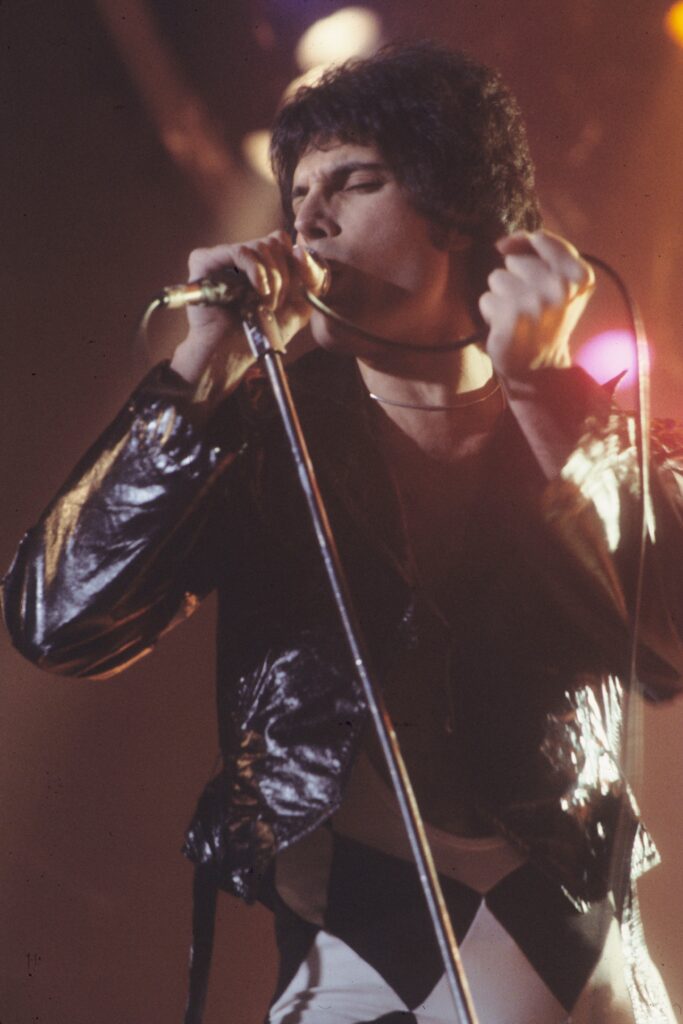
Featured image: Freddie Mercury performing at a WPLR show in New Haven, Connecticut, 16 November 1977. Photograph by Carl Lender, CC BY 2.0, via Wikimedia Commons. This photograph predates and does not document the 2026 V&A display. No modifications beyond automatic WordPress resizing.
