
On Tuesday, October 20, Dulwich Picture Gallery opened Hokusai: Thirty-Six Views of Mount Fuji from the Iuchi Collection in London. For the first time in the United Kingdom, the complete cycle can be seen together: the original thirty-six colour woodblock prints made around 1830–33, followed by ten more designs added after their success.
One mountain, forty-six ways of seeing
Hokusai treats Mount Fuji less as a fixed landmark than as a changing measure of human experience. It rises over working streets, appears through bridges and barrels, recedes behind travellers, and holds steady while weather turns violent. The sequence continually shifts scale and viewpoint, asking viewers to search for the mountain even when ordinary life crowds the foreground.
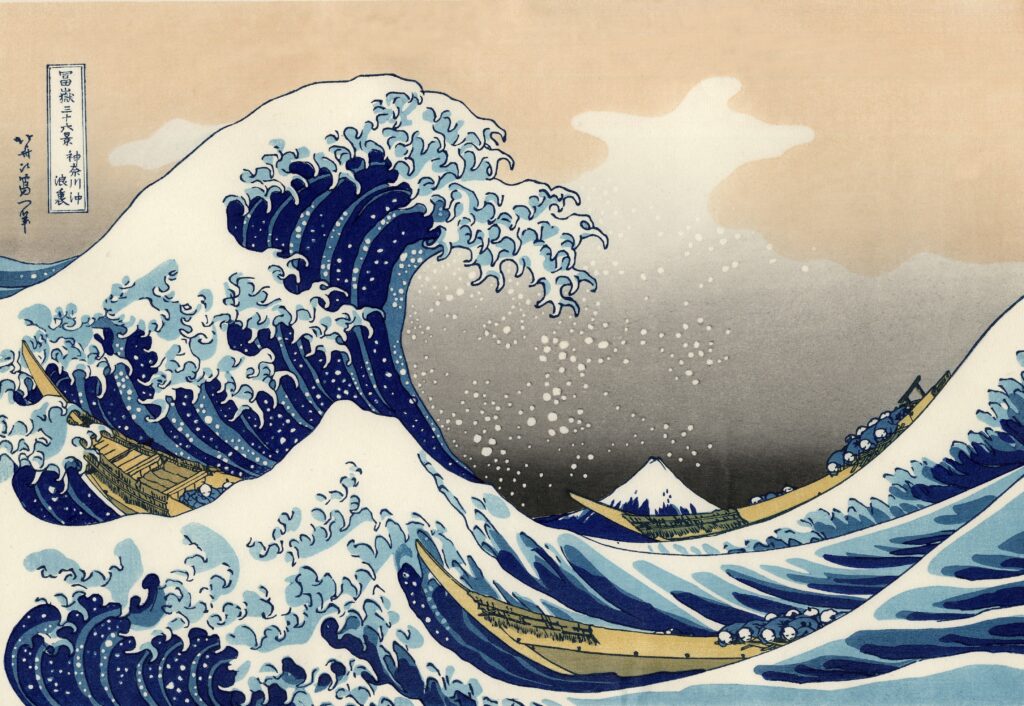
The most famous sheet, Under the Wave off Kanagawa, compresses that method into a single unforgettable image. Boats and rowers are caught beneath a crest that seems to echo the distant cone of Fuji. A Guardian review draws attention to three impressions in the exhibition, showing how close comparison can unsettle the familiarity of an image reproduced almost everywhere.
Elsewhere, a gust at Ejiri sends hats and papers spinning across the road, while Fuji remains almost casually present on the horizon. In Clear Day with a Southern Breeze, the mountain becomes the entire drama. Dulwich is showing a rare “Red Fuji” variant never before seen in the UK alongside an unusually preserved impression of the Great Wave.
Blue pigment, global influence
The series also records a technical and cultural crossing. Hokusai used imported Prussian blue with unusual confidence, building depth through saturated colour and sharp tonal contrast. Western linear perspective entered Japanese print culture, but the exchange soon travelled in the other direction. Hokusai’s framing, serial thinking and attention to changing conditions would help reshape how European artists imagined landscape.
That influence becomes clearer when the prints are encountered as a cycle rather than as isolated icons. The Times notes that the early impressions from the Iuchi Collection retain exceptional clarity, allowing Hokusai’s humour and close observation to emerge alongside the formal invention. Fuji may be sacred and enduring, but the lives around it are busy, precarious and often comic.
The exhibition was organised with the Iuchi Collection and the National Museum of Western Art, Tokyo. Its arrival at Dulwich turns a universally recognised wave back into one episode within a much larger meditation on work, weather, movement and time.
Seen together, the forty-six prints reveal why Hokusai’s achievement exceeds any single masterpiece. Mount Fuji becomes a constant that can absorb endless variation: distant or dominant, serene or threatened, physical landmark or spiritual idea. The complete sequence makes repetition feel expansive, and shows how one place can generate a world of images.
Image: Katsushika Hokusai, Under the Wave off Kanagawa (The Great Wave), c. 1830–33, from Thirty-Six Views of Mount Fuji. Faithful reproduction of a public-domain work, via Wikimedia Commons, Public Domain Mark 1.0. The work is included in the Dulwich exhibition; this reproduction is not the Iuchi Collection impression.
