
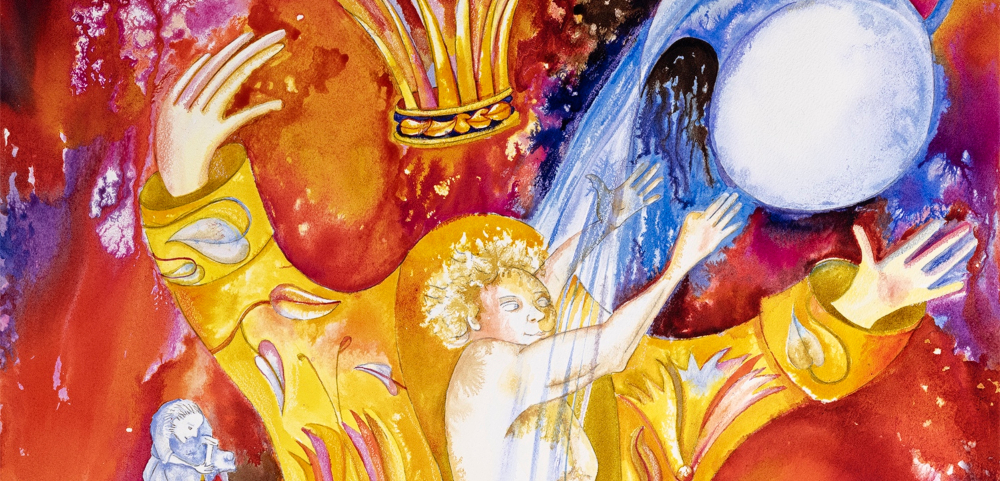
Australian theatre designer and visual artist Kim Carpenter turned the life and writing of Oscar Wilde into a series of paintings shown in Sydney in April 2022.
Titled Wilde: Life and Fantasy, the exhibition drew on stories including The Happy Prince, The Selfish Giant and The Young King. Carpenter used Wilde’s fiction as a framework for considering beauty, poverty, desire and social exclusion.
From stage design to painting
Carpenter’s long career in theatre shaped the exhibition’s visual language. As a designer and director, he had worked across performance, puppetry, dance and acrobatics, often building narratives through image and movement rather than dialogue.
His Theatre of Image developed this approach through productions in which visual composition carried much of the storytelling. Carpenter also collaborated with choreographer Graeme Murphy on an Australian staging of Wilde’s The Happy Prince, an experience that connected his theatrical practice directly with the writer’s work.
A biography organised through stories
For the exhibition, Carpenter treated Wilde’s stories as markers within the author’s biography. Different groups of paintings used distinct palettes to reflect particular episodes, moods and characters.
One work, Rascally Street, presented a crowded urban scene filled with lovers, beggars, strolling figures and people watching from windows. Its vivid colour and unstable architecture suggested both theatrical fantasy and the harsher social realities that informed Wilde’s writing.
Carpenter’s paintings did not simply illustrate literary scenes. They combined the artist’s own experience of theatre with Wilde’s concern for outsiders and his ability to move between wit, beauty and tragedy.
Wilde: Life and Fantasy was shown at Barry Stern Studio in Paddington, New South Wales, from 2 to 16 April 2022. The exhibition demonstrated how a designer accustomed to building worlds for the stage could translate literary biography into a personal language of colour, character and imagined space.