

Marseille’s Mucem opened Manger les images on 28 October, turning an apparently impossible question into a material history: what does it mean to eat an image? Across 435 works and objects—250 drawn from the museum’s own collections—the exhibition follows six millennia of practices in which pictures are swallowed, shared, destroyed or transformed. Its subject is not simply food in art, but “iconophagy”: the desire to acquire an image’s power by consuming it.
Curated by art historian Jérémie Koering with Mucem curator Raphaël Bories, the exhibition begins from a stubborn fact. Images have never existed only to be looked at. They have been worn as amulets, baked into bread, dissolved in water, printed on cakes and passed from hand to hand at rituals and celebrations. The Mucem’s ethnographic holdings make those gestures visible alongside loans from museums and libraries, bringing devotional objects, popular traditions and contemporary art into the same argument.
From communion wafers to cold-storage cakes
The display moves through three linked sections: imaginaries of ingestion, salvific images and banquets of images. Medieval communion wafers sit within a longer history of sacred consumption; moulds, figurative breads and confectionery show how an image can become both an offering and a meal. Many objects rarely leave storage, which gives the exhibition the feel of an archive suddenly made edible.
The scale matters. By placing humble utensils and festive objects beside engravings, photographs, films and performances, Manger les images resists a neat division between “high” art and everyday belief. An image may protect a body, carry knowledge, mark membership of a group or stage the destruction of an enemy. Eating, in this account, is a way of making the distant intimate. It can express devotion and affection, but also domination: to consume an image is sometimes to claim control over what it represents.
When the image eats back
Modern and contemporary artists sharpen that ambiguity. Works connected to Meret Oppenheim, Michel Journiac, Dennis Oppenheim and Léa Belooussovitch turn the mouth into a site where desire, identity and violence meet. The route ends in the media age, where David Cronenberg’s Videodrome offers a darker reversal: instead of viewers consuming images, images appear to penetrate and remake their viewers.
That final turn makes the exhibition feel unexpectedly current. Digital culture encourages an endless appetite for pictures, yet the Mucem asks visitors to consider their embodied power. Independent coverage likewise emphasizes the exhibition’s movement between ritual, social life and contemporary art.
Manger les images runs at the Mucem in Marseille until 12 April 2027. Rather than treating consumption as a curiosity, it proposes a useful reversal: images do not merely represent cultures. They enter bodies, organize communities and, sometimes, change the people who believe they are only looking. The result is a history of images as active social substances: things that cross thresholds between sight, touch, taste, memory and collective life.
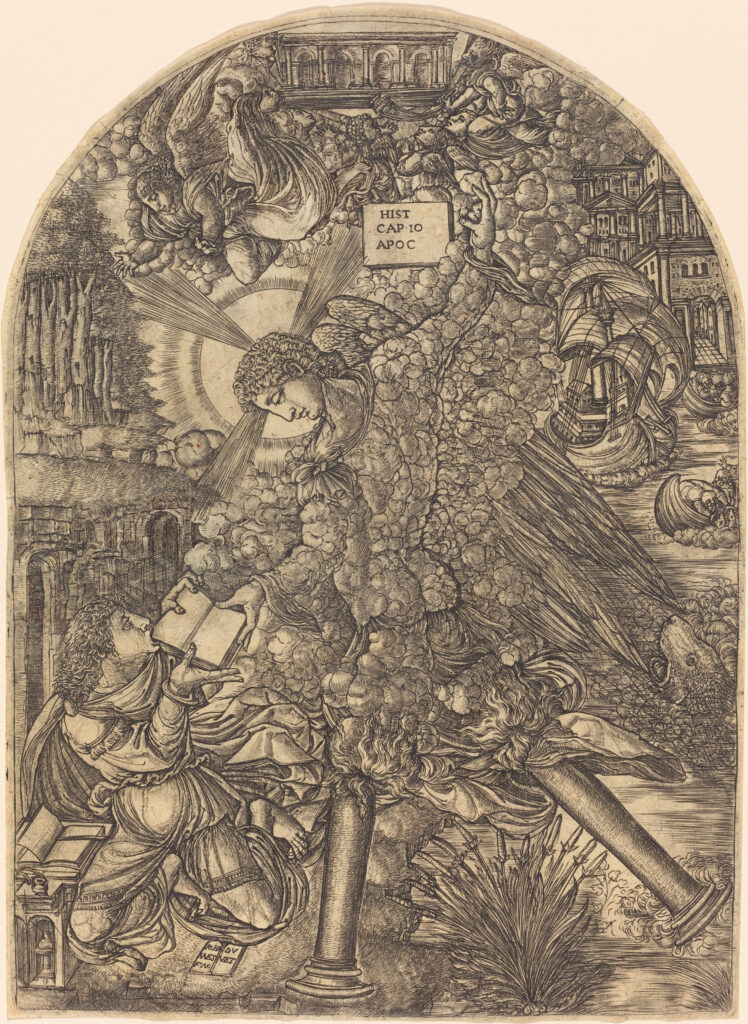
Image: Jean Duvet, The Angel Gives Saint John the Book to Eat, 1552–1556, engraving on laid paper, Rosenwald Collection, National Gallery of Art, Washington (1947.7.46). Public-domain, open-access image via Wikimedia Commons. This is a thematic illustration of iconophagy, not a confirmed view of the impression displayed at the Mucem. No editorial modification beyond automatic WordPress resizing.
