
Chassepierre Festival closed its 52nd edition on Sunday, 16 August, after turning the small Belgian village beside the Semois into an open-air stage. Theatre, circus, dance, music and large-scale puppetry occupied its lanes and riverside fields, while the final performances carried the programme beyond sunset.
Street arts change after sunset
A report published after the event by regional broadcaster TV Lux captured how darkness altered both the atmosphere and the artists’ work. Four high-wire performers from Minuit Compagnie crossed an illuminated structure twelve metres above the ground. With natural light gone and spotlights shining upwards, the artists had fewer visual reference points and had to adjust their balance.
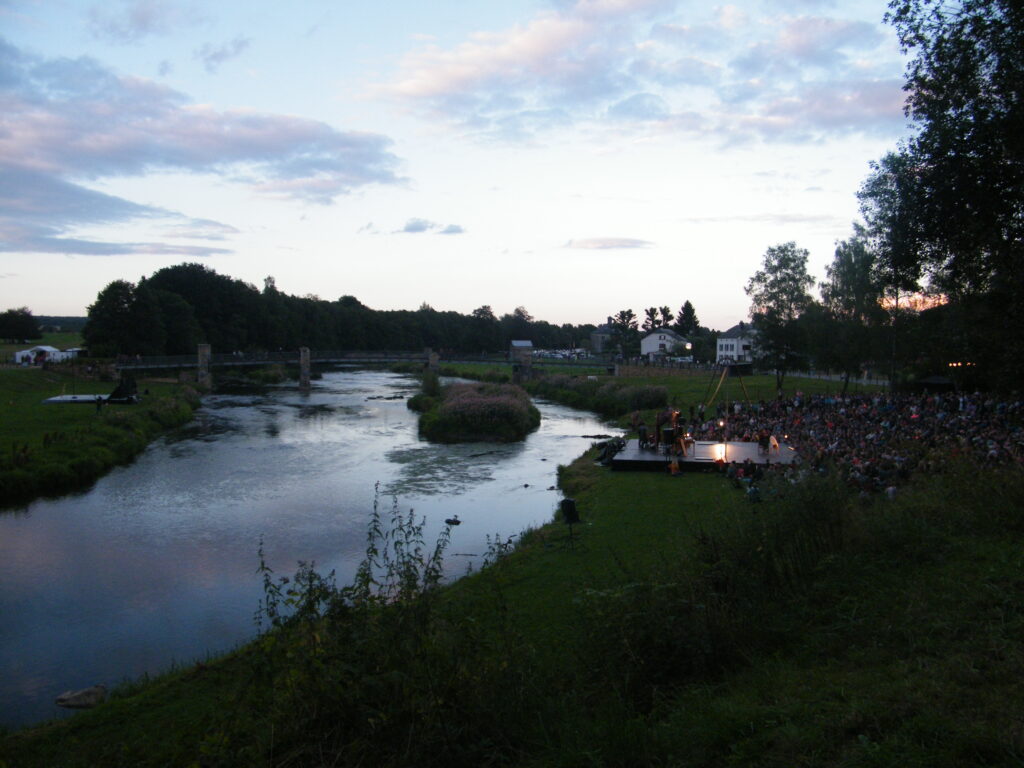
Paris Bénarès also presented Chevâl, a meeting between a performer and a monumental horse puppet. The production was not originally designed for artificial lighting, but the shadows created at night changed how the creature appeared and how its manipulators navigated the mechanism. Spectators remained on site after a day of intense heat, watching the village, bridge and stages take on a different character before musicians extended the evening under the marquee.
A village built into the programme
The 2026 edition brought together around 50 companies from Belgium, France, Germany and the Netherlands. Its theme, “Se Ressouvenir”, framed memory as a shared artistic resource rather than a fixed archive. Performances ranged from acrobatics and street theatre to dance, music, puppetry and digital forms. The setting is part of the event’s identity: a village of only a few hundred residents becomes a temporary network of stages across streets, meadows and the riverbank.
That relationship between performance and place gives the Chassepierre Festival a scale different from a conventional theatre programme. Audiences move between formal shows and unexpected encounters, while artists adapt to sloping ground, changing weather and the shifting light described in the closing-night report. The 16 August programme also included audio-described performances, with practical support designed to make several works more accessible to blind and visually impaired visitors.
The event’s longevity adds another layer to that temporary transformation. OutdoorArtsUK describes Chassepierre as Europe’s oldest festival dedicated to street arts. What began in the early 1970s has retained a deliberately mixed programme and a setting far from a metropolitan cultural district. The craft and food market, river crossings and movement between scattered performance spaces place the audience inside a changing environment, rather than in front of a single stage.
Sunday’s closing hours showed why that continuity matters. The event did more than place work outdoors: it allowed darkness, landscape and collective movement through the village to become active parts of the performance. The high wire, giant puppet and late music all acquired meaning from the conditions in which spectators encountered them.
Featured image: Festival de Chassepierre grounds between the Semois and rue du Breux, photographed in 2016. Contextual image; it does not depict the 2026 edition. Photograph by Tichon Samuel, via Wikimedia Commons, licensed under CC BY-SA 4.0. No modification beyond automatic WordPress resizing.
