
Four recent scores turned one New York concert into a compact survey of how composers are remaking the language of the ensemble.
On 17 August 2026, the International Contemporary Ensemble, conducted by Rebekah Heller, performed music by Njabulo Phungula, Imsu Choi, Farzia Fallah and Márton Illés at Mary Flagler Cary Hall in New York. The concert formed part of TIME:SPANS 2026, the annual festival devoted to twenty-first-century music at the DiMenna Center for Classical Music.
Four distinct approaches to sound
The programme brought together four works written between 2021 and 2025. Phungula’s ochre song received its New York premiere, while Choi’s Pop, Fallah’s I did not paint the war. I lived the war — une Aubade and Illés’s Forajzok were presented as United States premieres. The line-up placed emerging and established voices from several countries inside a single, tightly focused concert.
According to the festival’s detailed programme notes, Phungula built ochre song around imagined physical layers: grainy, fluid and earthy. Prepared harp strings, wooden percussion, bowed glissandi and shifting instrumental colours translate those materials into sound. Choi’s Pop, by contrast, began with an electronic popping noise shaped through a body-based motion sensor during the composer’s work at IRCAM. The small sound gradually expands into a mobile texture shared by acoustic instruments and electronics.
Fallah’s title draws on Picasso’s reflections about making art during wartime. Her score also looks towards L’Aubade, Dora Maar’s photographs of Guernica in progress and a poem by her father, Karim Fallah Rajabzadeh. These references frame the work as a meditation on conflict lived through bodies and memory, rather than observed from a safe distance.
A festival built around living composers
Illés’s Forajzok completed the programme with an unusually theatrical vocabulary. Conventional instrumental playing is mixed with vocal sounds and the striking, rubbing and scratching of coins. The result extends his continuing Rajzok series, in which gesture, colour and physical action help organise musical form.
The concert also demonstrated the practical scale of contemporary ensemble music. Seventeen performers covered winds, brass, strings, harp, piano and percussion, giving each composer a broad palette while keeping the interaction closer and more exposed than in a symphony orchestra.
Produced by the Earle Brown Music Foundation Charitable Trust, the festival has made concentrated listening its central proposition. An independent season preview described eleven concerts across fifteen days, with programmes centred on recent music and premieres. Within that wider sequence, the International Contemporary Ensemble’s appearance gave TIME:SPANS 2026 a deliberately international cross-section of new composition.
The evening mattered less as a contest between four styles than as evidence of their coexistence. Material processes, electronic gesture, political memory and physical theatre could occupy the same stage without being pressed into a single aesthetic. In just over an hour, the programme showed contemporary music not as one school, but as a field of distinct methods linked by close attention to sound.
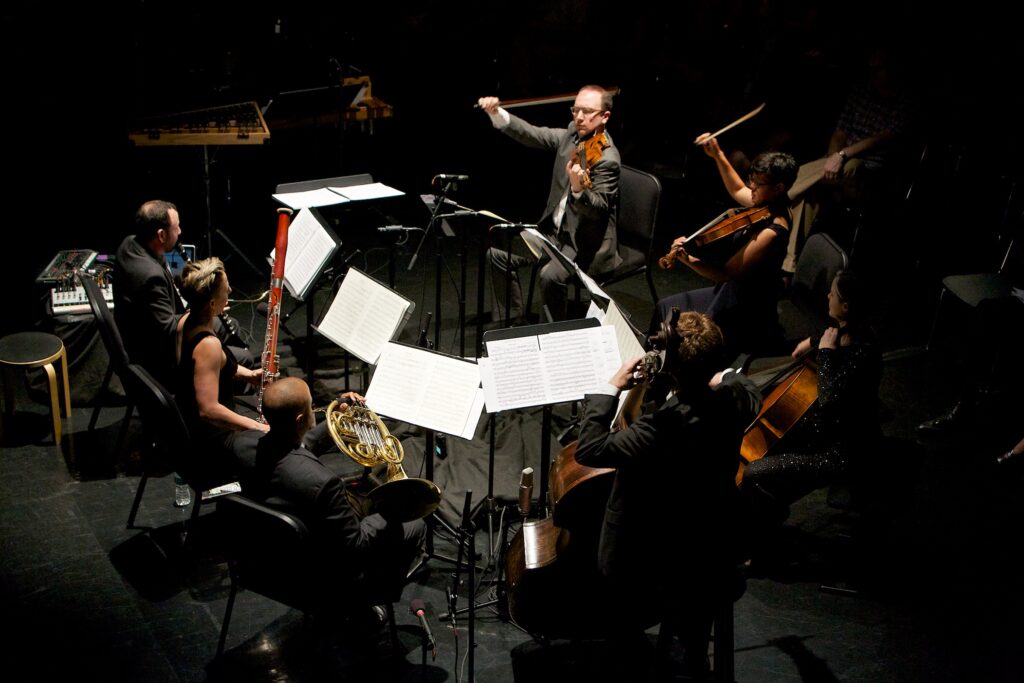
Image: the International Contemporary Ensemble performing at the Mostly Mozart Festival in New York on 22 August 2013. Contextual photograph, not the TIME:SPANS 2026 concert. Photograph by Sun medallion (Armen Elliott in the embedded metadata), via Wikimedia Commons, licensed under CC BY-SA 3.0. Source: Wikimedia Commons.
