

Thea Musgrave bassoon concerto Out of the Darkness received its world premiere at London’s Royal Albert Hall on 23 August 2026. Bassoonist Amy Harman joined the Academy of St Martin in the Fields, directed from the violin by Benjamin Marquise Gilmore, for a BBC Proms performance that turned movement through the orchestra into part of the music’s argument.
A premiere built as a journey
The new concerto began in literal and musical shadow. According to Susan Elkin’s review of the matinee, Harman started high among the players beside the xylophone, dressed in white and answering a motif from the orchestra’s leader. She then moved between instrumental groups before reaching the front of the stage. The choreography did not decorate the score; it made the soloist’s search visible.
That theatrical thinking extends a method Musgrave has developed for nearly six decades. In a Guardian interview published before the premiere, the 98-year-old Scottish-American composer traced it to a dream that inspired her 1967 Concerto for Orchestra. Instead of treating musicians as a single obedient body, she gives them individual agency: they stand, move, challenge one another and reshape the drama of performance.
From isolation towards a shared melody
In Out of the Darkness, that dramatic language carries a direct emotional idea. Musgrave described the work as emerging from the collective gloom of the Covid period. The bassoonist begins within that darkness until the concertmaster introduces a melody that acts as a voice of hope. Harman’s journey through the ensemble follows that sound, encountering unusual instrumental colours on the way.
The destination is deliberately more complex than a triumphant cure. Musgrave has said the ending holds darkness and light together, replacing easy reassurance with determination. The Thea Musgrave bassoon concerto therefore makes hope an action rather than a mood: the soloist must listen, travel and form connections before arriving in a new position.
A world premiere inside a generous matinee
The published Proms listings placed the commission between Britten’s Simple Symphony, Mozart’s Third Horn Concerto with Felix Klieser, Elgar’s Romance for bassoon and Mozart’s “Haffner” Symphony. Elkin reported that Musgrave’s complex staging remained clear in performance and described the piece as an argument for hope, confirming both the concert’s completion and the premiere’s physical design.
At 98, Musgrave is not revisiting an old formula. She is refining a lifelong question about how individuals behave inside a collective. On 23 August, a bassoon moving through an orchestra gave that question a new public form—and allowed one of contemporary music’s most distinctive dramatic imaginations to keep moving forward.
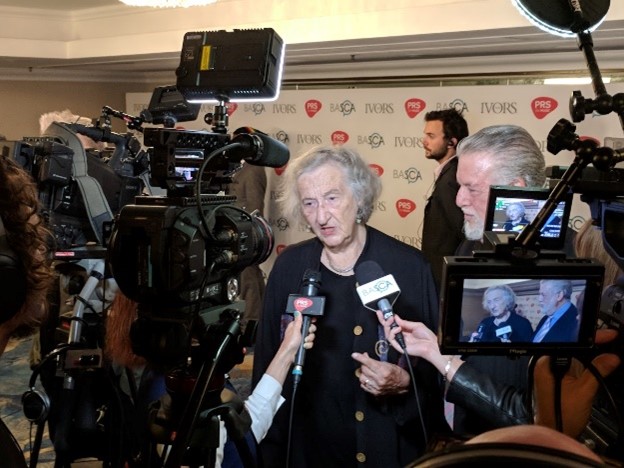
Image credit: Thea Musgrave speaking at the Ivor Novello Awards in London on 31 May 2018. Contextual portrait only; it does not show the premiere, Amy Harman or the BBC Proms concert of 23 August 2026. Photograph by Thomas Le Brocq, licensed under CC BY-SA 4.0. Source: Wikimedia Commons. No editorial modification; WordPress generated resized versions.
