

The American Folk Art Museum opened Locating Girlhood: Place and Identity in Early American “Schoolgirl” Art in New York on 9 October, bringing nearly 100 objects into an argument that is both visual and historical. Rather than treating samplers, needlework pictures, maps and watercolours as charming evidence of domestic education, the exhibition asks what girls were saying about place, identity and belonging through them.
Drawn from more than 35 museums and private collections, the show places celebrated works beside objects rarely seen in public. Its premise is pointed: long before the Hudson River School made landscape a central story of American art, girls and young women were already constructing country scenes, town views, maps and imagined environments in silk, paint and ink.
Landscape history before the Hudson River School
Curators Emelie Gevalt and Caroline Culp have organised the exhibition around the recurring presence of place. Their approach shifts attention from the traditional questions of attribution, school and regional style toward the visual ideas inside the works. Houses, churches and academies become more than background. They connect needlework to drawing, geography, geometry and civic education, showing how the act of making could also be an act of situating oneself in a changing nation.
Among the works is a monumental 1754 needlework picture attributed to Faith Trumbull, whose artistic example influenced her younger brother John Trumbull. Mary King’s Tree of Life, made in Philadelphia the same year, turns silk, metallic thread and glass beads into a teeming garden of animals and vines. Juliana Carpenter’s Map of Two Hemispheres, completed in 1825 when she was 15, places a miniature self-portrait between two mapped worlds.
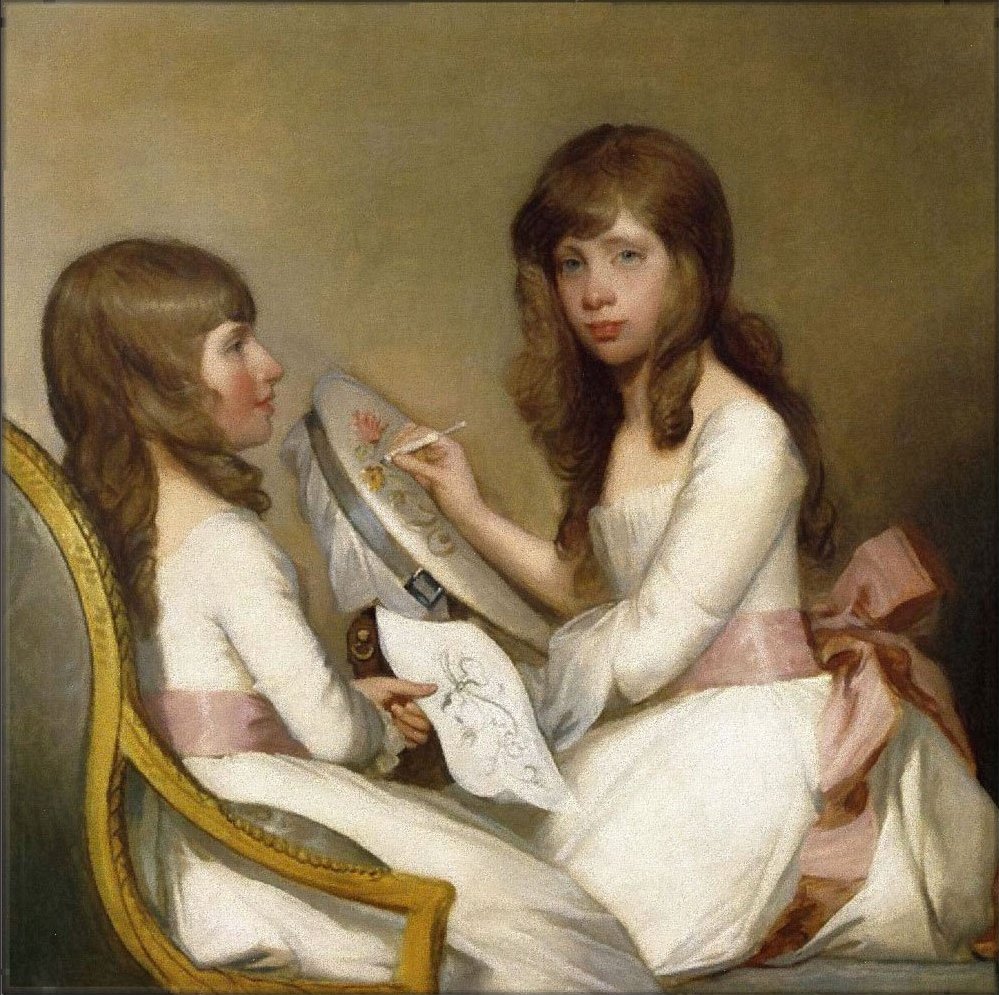
Gilbert Stuart’s double portrait Anna Dorothea Foster and Charlotte Anna Dick, also on view, makes the educational setting visible: one young woman holds a floral pattern while the other works at a tambour embroidery frame. The painting becomes a bridge between activities once separated as fine art and feminine accomplishment.
Whose place counts in a national story
Locating Girlhood also widens the field beyond the white New England examples that have dominated earlier accounts. Works from the South, the Midwest and Canada appear alongside a section devoted to Black girls and the expansion of educational opportunity. The curators note that only 45 surviving samplers documented to Black girls are known, making each object evidence of both artistic ambition and restricted access.
That emphasis gives the exhibition a productive tension during the United States’ 250th-anniversary year. These works participated in ideas of home, liberty and national identity, yet they were made within systems shaped by gender, race and colonial power. By treating them as art rather than marginal craft, the museum does more than recover overlooked makers. It changes who can be understood as an early interpreter of the American landscape.
Locating Girlhood runs at the American Folk Art Museum through 28 February 2027. Admission is free.
Featured image: Gilbert Stuart, Anna Dorothea Foster and Charlotte Anna Dick, 1790–1791, oil on canvas, Reynolda House Museum of American Art. Public Domain Mark 1.0. The work is included in the exhibition.
