
On 10 October, the Museum of Fine Arts Ghent opened a retrospective devoted to Jenny Montigny, restoring a local Impressionist to the institution where her ambition first took shape. The exhibition presents Montigny as more than a gifted follower of Emile Claus: across paintings, pastels, drawings and etchings, it argues for an independent artist whose luminous surfaces carried a sharply personal view of work, childhood and domestic life.
Montigny was born in Ghent in 1875. According to the museum, she was sixteen when Claus’s The Skaters stopped her during a visit to the collection and pushed her towards an artistic career. She later studied in his outdoor classes near Deinze, joined the luminist circle Vie et Lumière in 1904 and settled in Deurle, near Sint-Martens-Latem. Yet the retrospective’s purpose is not to keep her inside her teacher’s story. It follows the visual language she developed from the light, spaces and people around her.
Light becomes lived experience
Montigny repeatedly painted the local school and its sunlit playground, subjects the museum describes as unrivalled within her work. Children gather, move and dissolve into fields of color; rural scenes along the Lys turn agricultural labor and ordinary paths into shifting atmospheres. Interiors, portraits, motherhood and childhood bring that same attention to quieter spaces. Rather than treating light as a decorative effect, she used it to structure memory and intimacy.
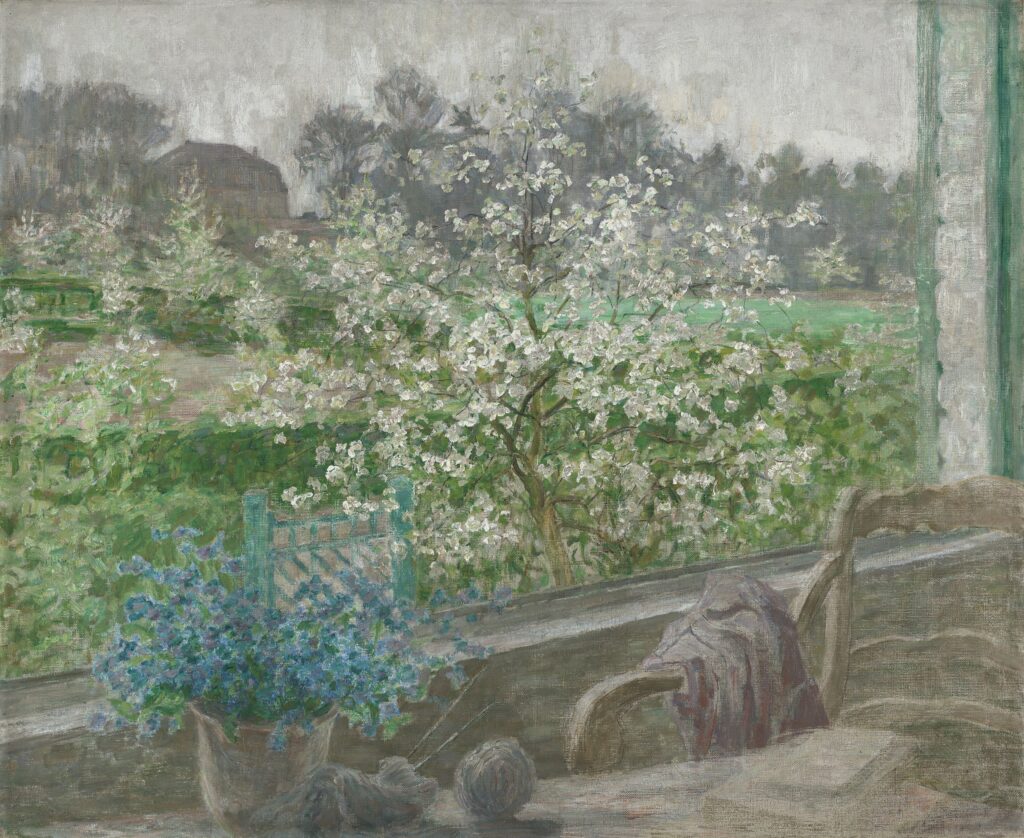
My Window, painted around 1910 and now in the MSK collection, crystallizes that approach. The room opens onto a garden through broad bands of green, cream and violet, while objects on the sill anchor the view in daily life. Visit Flanders confirms that the painting is included in the exhibition. Its fusion of interior and landscape also shows why Montigny’s art cannot be reduced to an echo of Claus.
A career wider than the Lys
The exhibition extends beyond the idyllic image often attached to Belgian luminism. During the First World War, Montigny lived in London. There she observed society in the city’s parks, but also wounded Belgian soldiers receiving treatment, recording both worlds in drawings and etchings. That shift in subject complicates the idea of an artist concerned only with rural serenity.
Montigny organized a major retrospective at Ghent’s Cercle Artistique et Littéraire in 1922. After Claus’s death in 1924, her financial situation deteriorated, and her work gradually slipped from view. The MSK’s new survey therefore carries a symbolic weight: more than a century after that earlier retrospective, the city is reconsidering an artist who built a career in Belgium and abroad, then disappeared from the dominant narrative.
Open through 10 January 2027, Jenny Montigny does not simply recover a forgotten woman painter. It asks viewers to see how an artist associated with a celebrated male mentor transformed shared techniques into a world distinctly her own—intimate, observant and flooded with restless light.
Featured image: Jenny Montigny, My Window, c. 1910, Museum of Fine Arts Ghent. The painting is included in the 2026 retrospective. Public Domain Mark 1.0. Source: Wikimedia Commons.