


Boston’s Museum of Science opened the William and Charlotte Bloomberg Public Science Common on October 10, turning a former windowless theater into a glass-walled civic stage for science, technology and performance. The 10,000-square-foot venue overlooks the Charles River, with views stretching toward both Boston and Cambridge.
The opening follows more than two years of construction and forms part of a transformation supported by a $155 million gift from Bloomberg Philanthropies, the largest donation in the museum’s history. Named for Michael Bloomberg’s parents, the space is designed by Boston-based William Rawn Associates and built by Consigli Construction.
A room designed to keep changing
The architecture is deliberately mutable. Retractable seating can accommodate up to 300 people, while the standing capacity rises to 700. Movable walls divide the room for simultaneous programs, then disappear into the ceiling to restore a single hall. Three tall glass elevations replace the enclosure of the former Cahners Theater, opening the museum visually toward the river and skyline.
That flexibility extends to the building’s media system. Six LED screens travel on a ceiling-mounted track and can be rearranged for talks, demonstrations or performances. Room-darkening shades turn the glass volume into a projection surface. A spatial-audio system and extensive soundproofing allow immersive presentations without overwhelming the galleries around it.
The result is less a conventional auditorium than a piece of programmable architecture. In its report on the opening, the Boston Business Journal described a project led by women across the museum, architecture and construction teams—an uncommon configuration for a cultural build of this scale.
Where science meets visual culture
The Public Science Common also brings Ars Electronica’s Deep Space system to the United States. Developed by the Austrian media-arts institution, the platform combines high-resolution wall and floor projection with real-time data and interactive tracking. At the museum, it can move audiences across Mars, beneath the ocean or inside a living cell, translating scientific research into a shared visual environment.
The museum says the hall will host scientists, artists, performers and public figures, alongside daily demonstrations for general visitors. Robotics, sound experiments and immersive displays are already part of the preview program; later events range from conversations about artificial intelligence to architecture and engineering.
This mixture matters. Science museums have long relied on objects and explanatory displays, but the new Common treats public understanding as a live event—something staged, debated and experienced together. Its name is therefore more than branding: the room is conceived as common ground, not simply another gallery.
The October 10 opening was a soft launch, ahead of a larger celebration scheduled for October 28. Even in this first phase, the project gives the Museum of Science a new public face: transparent, technically ambitious and built to change with the questions placed inside it.
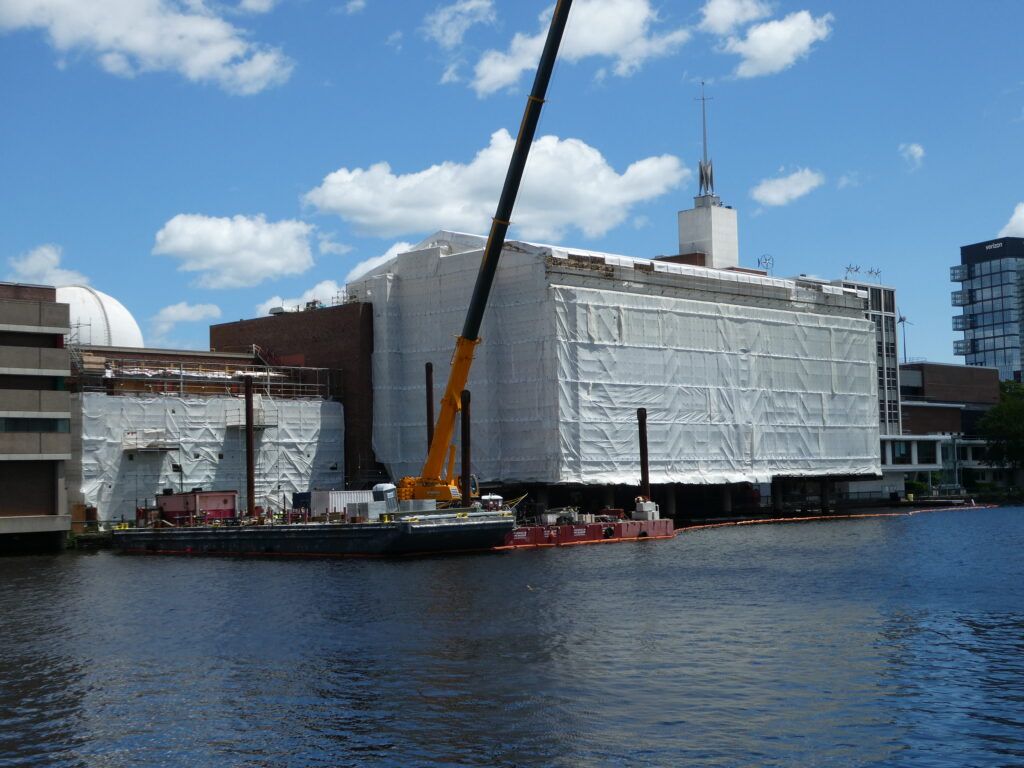
Image credit: the Museum of Science during renovations in June 2025. Photograph by Pi.1415926535 / Wikimedia Commons, CC BY-SA 4.0. This photograph documents construction, not the October 2026 opening.
