

Phoenix.Sun, a new solo created and performed by Kasia Wolińska, received its world premiere at Berlin’s St. Elisabeth-Kirche on 24 August 2026. Presented by Tanz im August, the hour-long work brought choreography, live music and video into a shared meditation on destruction, mourning and renewal.
A body moving through fire
Wolińska developed the performance with composer and sound artist Heinali, video artist Denis Kozerawski and dramaturge Jette Büchsenschütz. Rather than treating fire as a spectacular effect, the team uses it as a structure for thinking. The dancing body repeatedly moves through states of emergence and disintegration, while sound and images create a world that appears to burn and remake itself.
The starting point is both political and ritual. According to the Adam Mickiewicz Institute, the work grew from an urge to kindle a fire and imagine a world engulfed in flames anew. Its references include the pyrotechnic sculptures of Polish artist Władysław Hasior, whose burning forms were connected to the memory of birds falling from wartime skies.
From Hasior to Hildegard
The piece also enters into dialogue with Hildegard of Bingen’s idea of viriditas: a life-giving greenness understood as spiritual vitality. Bringing that image beside Hasior’s fire allows the choreography to hold terror and regeneration in the same frame. Ash is not presented as a neat ending. It becomes material from which another gesture, sound or image might arise.
That tension suits Wolińska’s wider practice. Born in Gdańsk and based between Berlin, Vienna and the Polish city, she works across choreography, performance and writing. Her projects often connect bodily experience with political and cultural analysis. Here, a single performer becomes a changing field rather than a fixed character: vulnerable to destruction, yet capable of summoning another beginning.
A premiere shaped by its setting
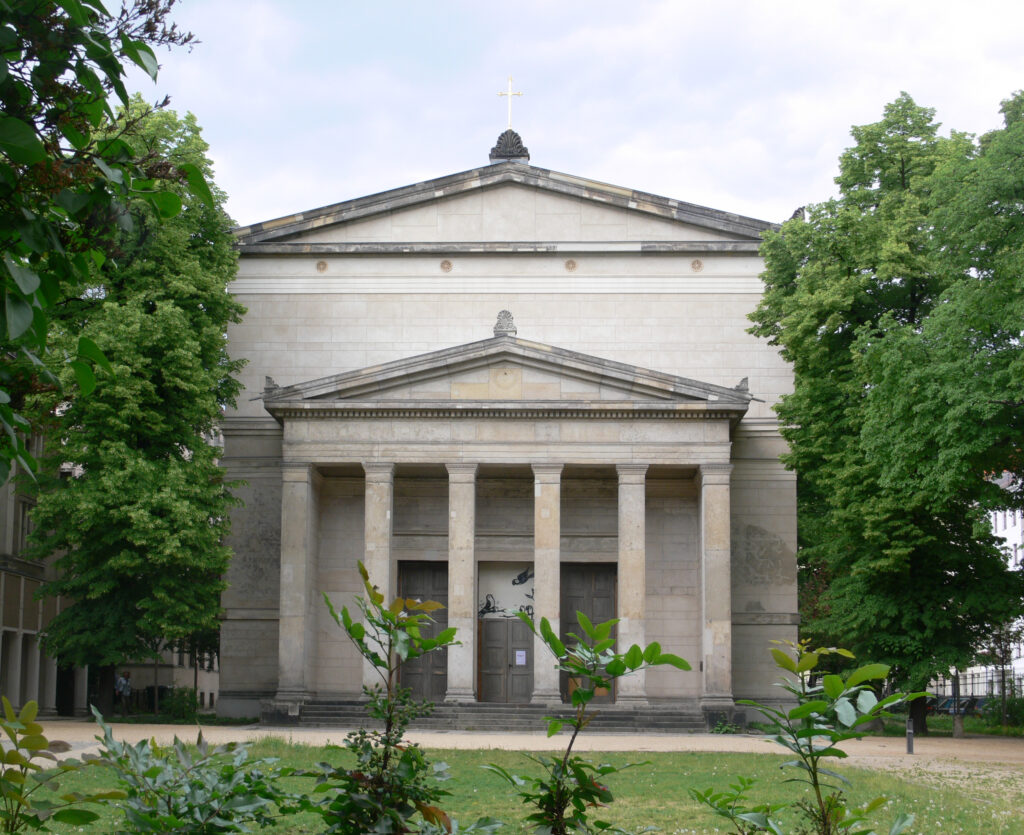
The venue sharpened that proposition. St. Elisabeth-Kirche, designed by Karl Friedrich Schinkel in the 1830s, was heavily damaged during the Second World War and later restored as a cultural space. A performance concerned with ruins and renewal therefore unfolded inside architecture that already carries those histories. The venue’s programme describes the work as a collective evocation of beauty, horror and transformation.
The current Berlin Bühnen schedule lists further performances on 25 and 26 August, while the festival page places the 24 August presentation among its past dates. The Phoenix.Sun premiere thus opened a three-night encounter in which fire is neither illustration nor finale. It is a choreographic question: what can a body carry forward after the world around it has changed?
Image credit: St. Elisabeth-Kirche in Berlin-Mitte, photographed in May 2008. Contextual image only; it does not show Phoenix.Sun, Kasia Wolińska or the premiere of 24 August 2026. Photograph by Andreas Praefcke, licensed under CC BY 3.0. Source: Wikimedia Commons. No editorial modification; WordPress generated resized versions.
