
On 25 August 2026, a new Credo entered Bach’s Mass in B minor as the Lausitz Festival opened at the Church of St Peter and Paul in Görlitz, Germany. The evening also awarded the inaugural Credo Prize to Czech theatre-maker Petr Štědroň, connecting musical creation, cultural conviction and a region in transition.
A belief written into Bach
The seventh Lausitz Festival began with music that placed a contemporary act of belief inside one of the landmarks of the choral repertory. The concert combined extracts from Johann Sebastian Bach’s Mass in B minor with the world premiere of a new Credo by French composer and conductor Sylvain Cambreling. A television report broadcast by MDR the following day confirmed that the festival had opened.
The British choir Tenebrae and the Kammerorchester Basel performed under Nigel Short. According to the festival’s programme, Cambreling’s commissioned Credo followed the Kyrie and Gloria, continuing Bach’s score through a new statement of I believe. The choice was more than a musical intervention. It established the 2026 theme, geschöpferisch, a coined German word joining ideas of creature and creator, and linked artistic invention to a region still negotiating economic and social change.
A prize for cultural conviction
The opening also introduced the Credo Prize, a new biennial and non-monetary distinction for cultural figures whose work treats art as a socially consequential force. Its first recipient was Czech theatre director, dramaturg and translator Petr Štědroň. The award and the newly composed Credo were conceived as parallel gestures, turning an institutional honour into part of the evening’s artistic structure.
Born in Brno in 1976, Štědroň has led Prague’s Divadlo na Zábradlí since 2013 and directs the German-language theatre festival in Prague. Nachtkritik also notes his extensive work translating German-language drama, prose and poetry into Czech. That record makes the choice particularly resonant in Görlitz, a border city facing Poland and located within a wider Central European cultural corridor.
Culture across a changing region
Running until 13 September, the Lausitz Festival brings theatre, music, literature, photography and debate to towns across Saxony and Brandenburg. Its geography is central to its identity. Performances take place not only in established cultural buildings but also in churches, industrial monuments and other sites shaped by the region’s history. The programme treats structural transformation after coal not as background scenery, but as a question that culture can examine from several angles.
Founded in 2020, the festival has developed this regional approach while drawing artists from outside Lusatia. That balance matters: the event is not simply using unusual buildings as stages, but asking how inherited places and international practices can meet without flattening local experience.
The opening in Görlitz therefore did more than inaugurate three weeks of events. By placing a new composition inside Bach, presenting a prize devoted to cultural conviction and gathering international performers in a regional Gothic church, it made the festival’s argument tangible. Renewal, in this formulation, does not require abandoning inherited forms. It can begin by listening to them closely, then answering in a present-day voice.
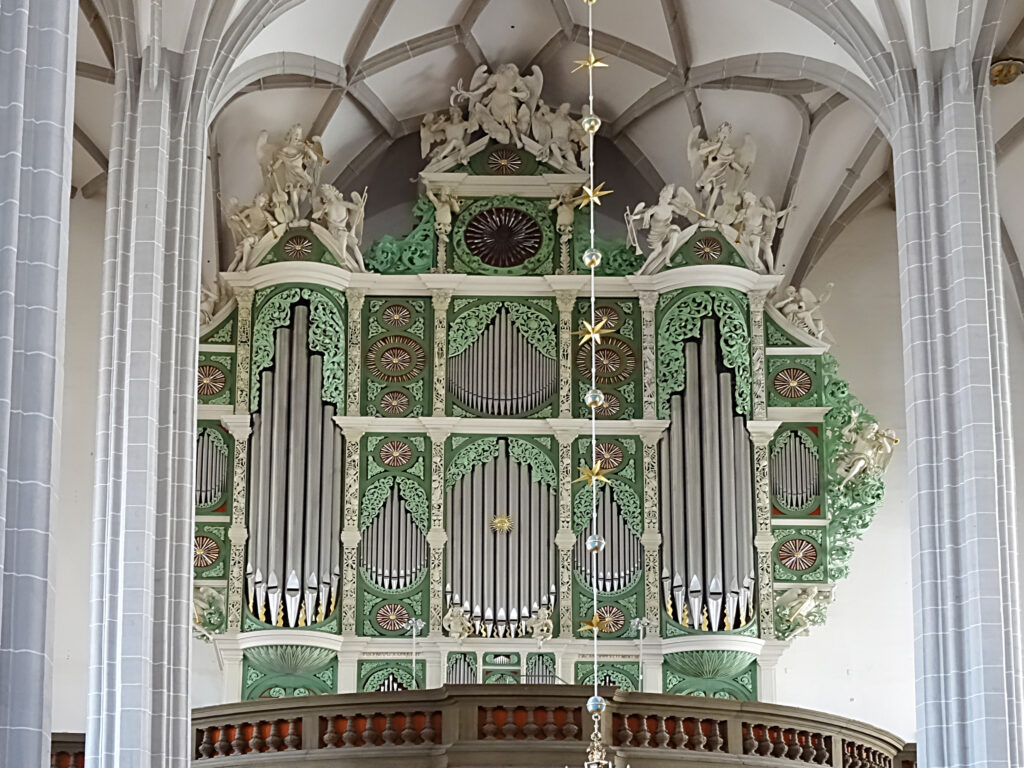
Image credit: The Sun Organ inside St Peter and Paul Church in Görlitz, photographed on 30 June 2018 by ErwinMeier. Contextual image only; it does not show the Lausitz Festival opening, the performers, the Credo premiere or the prize ceremony of 25 August 2026. Licensed under CC BY-SA 4.0. Source: Wikimedia Commons. No editorial modification; WordPress generated resized versions.
