
Portland’s citywide triennial connects new commissions, inherited languages and fragile forms of belonging. Curated by Lumi Tan, the exhibition asks what remains after a shared experience ends.
Converge 45 is presenting Here, To you, Now across Portland, Oregon, during an opening weekend running from 27 to 30 August 2026. The citywide triennial brings together 28 artists and 17 new commissions. Its exhibitions extend into the autumn, with different schedules at individual venues. This is an exhibition in progress, not a single opening-night event.
Tan’s curatorial premise draws on Ursula K. Le Guin’s 1985 novel Always Coming Home, particularly its distinction between writing and speech. A spoken exchange belongs to particular people at a particular moment. The exhibition translates that attention to impermanence into questions about how communities transmit knowledge, adapt to displacement and preserve relationships when their circumstances change.
Knowledge carried through art
At Portland State University, Patricia Vázquez Gómez’s The Mayan Works Chapter 2 develops her collaboration with Mayan families in Northeast Portland. Sound, drawings and a book modelled on a Mayan codex bring the transmission of maayat’aan, an Indigenous language from Yucatán, into the gallery. Language is treated as something carried by living people, rather than an object detached from its speakers.
Musician Marisa Anderson describes one component, Quartet for Five Voices, as four compositions developed from a soundscape made with Portland-born Mayan young people. Anderson, Leika Mochan, Fernando Vigueras and John Niekrasz contributed musical responses to the recorded language. Their layered collaboration gives the triennial’s concern with shared knowledge a specific form.
Elsewhere, Trisha Baga’s MORE combines 3D video and sculptural staging at the Portland Institute for Contemporary Art. PICA documents the installation as already on view from 20 August, with its reception scheduled for 28 August. The work connects consumer artificial intelligence with the artist’s experience of parenthood, considering how technological appetite and the demands of care might illuminate one another.
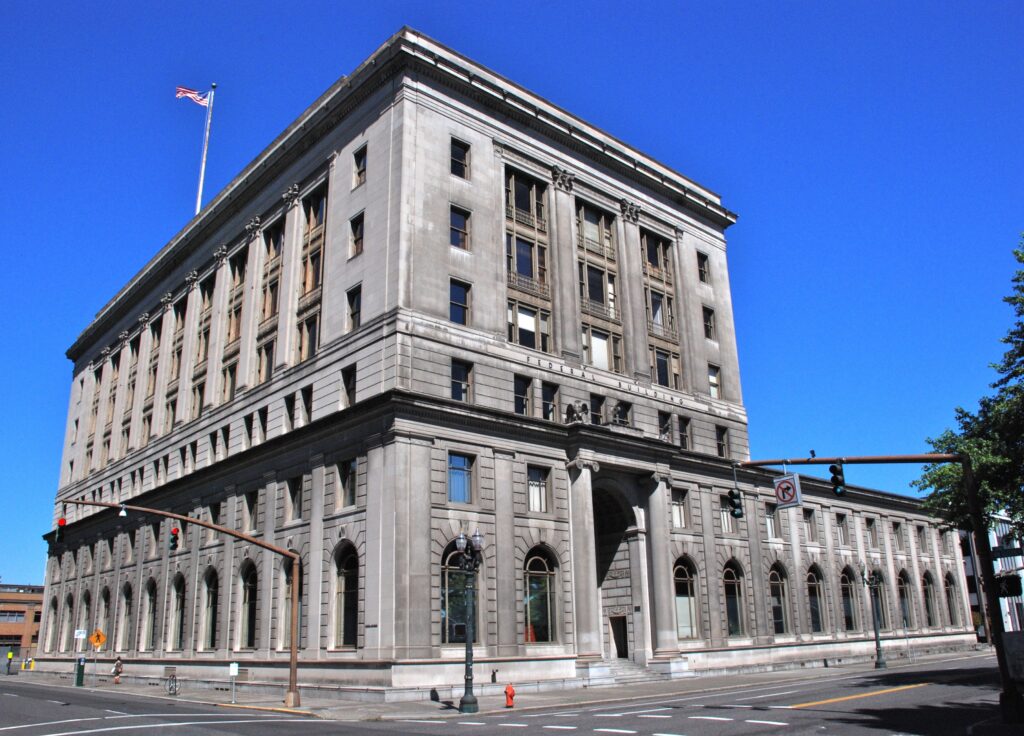
At the Pacific Northwest College of Art, Ido Radon approaches uncertainty through games and engineering. Sculptural structures assembled from vintage Erector sets draw on chess and Chutes and Ladders. Strategy, chance and the possibility of rearrangement become tools for thinking about agency.
The distributed format matters as much as the individual projects. In an interview with Observer, Tan situated her research within Portland’s artist-led networks and its history of organising to gain recognition beyond the region. University galleries and alternative spaces are therefore more than interchangeable containers: they are part of the relationships through which the work becomes possible.
The result invites a slower encounter than a checklist of openings. Writing in the Portland Mercury, Martha Daghlian foregrounds the time these works ask of viewers. Converge 45’s central proposition is best tested at that scale: in sustained listening, close looking and the temporary company of other visitors.
Contextual image: 511 Federal Building (Portland) – wide.jpg, photographed by Steve Morgan on 2 July 2011. The building now houses PNCA, a triennial venue; this photograph does not show the 2026 exhibition or its opening. Wikimedia Commons, CC BY-SA 3.0. No editorial alterations; WordPress generated resized versions and a square thumbnail.
_-_wide.jpg)