


San Francisco Ballet closed the Edinburgh run of Mere Mortals with a live collision of choreography, orchestral electronics and digital imagery.
San Francisco Ballet brought the Edinburgh run of Mere Mortals to its final scheduled performance at the Edinburgh Playhouse on Sunday 30 August. The European premiere paired Aszure Barton’s choreography with a live score by Floating Points, performed with the Royal Scottish National Orchestra, and large-scale visuals by Hamill Industries.
The 8pm performance cast Nikisha Fogo as Pandora, Fernando Carratalá Coloma as Prometheus, Parker Garrison as Epimetheus and Mingxuan Wang as Hope, alongside an ensemble of almost 40 dancers. Martin West conducted the orchestra. The production marked San Francisco Ballet’s first Edinburgh International Festival appearance in more than two decades.
Pandora enters the AI age
Commissioned by artistic director Tamara Rojo and first staged in San Francisco in 2024, Mere Mortals uses the myth of Pandora’s jar as a frame for questions about artificial intelligence, curiosity and responsibility. The company describes the ballet as an immersive encounter between movement, electronic music and visual technology rather than a conventional retelling.
That distinction matters. Barton gives recognisable mythological roles to principal dancers, but the work does not move through a clearly explained chain of events. Human bodies form changing masses, split into smaller encounters and repeatedly compete with the scale of the screen above them. A San Francisco Ballet production note says most projected imagery was made through practical, in-camera effects, with AI used for part of Pandora’s creation sequence.
Sound, bodies and digital spectacle
Floating Points, the stage name of composer and producer Sam Shepherd, builds the score from electronics and a full orchestra. The live arrangement gives the dancers both a propulsive pulse and a shifting acoustic landscape. Hamill Industries’ imagery expands the sense of scale, while Michelle Jank’s costumes separate the work’s darker opening world from its later gold-toned figures.
The first Edinburgh reviews agreed on the production’s sensory force while questioning its dramatic clarity. In The Guardian, Lyndsey Winship described a collision of dance, concert and visual spectacle, but argued that the Pandora parallel remains difficult to read without outside explanation. The Times similarly judged the European premiere as a powerful experience in which spectacle can outweigh narrative substance.
A European premiere built on tension
That tension is central to the work’s contemporary relevance. Mere Mortals asks audiences to watch highly trained bodies while digital surfaces repeatedly demand their attention. Its subject is not simply whether technology is threatening or useful, but how quickly a new tool can reorganise perception, labour and collective behaviour.
After four Edinburgh performances from 28 to 30 August, the production is due to continue to Sadler’s Wells in London from 9 to 12 September. The Scottish run established the ballet’s European presence through a collaboration that joined a US company, a Canadian choreographer, a British electronic musician, Spanish visual artists and a Scottish orchestra.
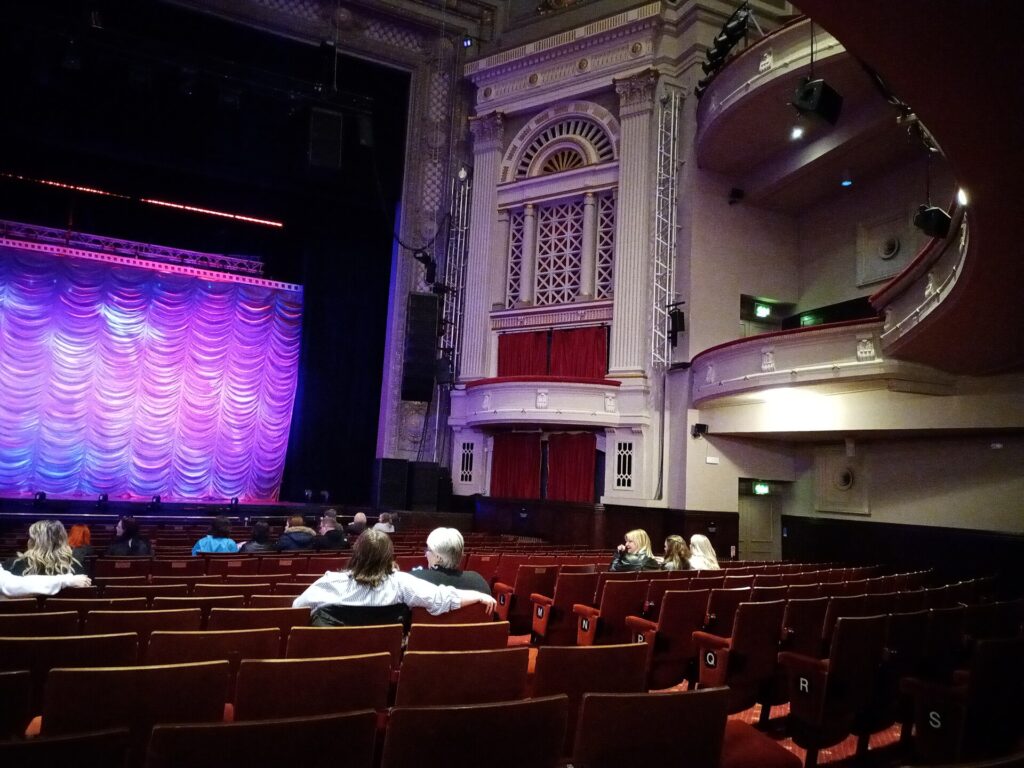
Image credit: Edinburgh Playhouse interior in 2023. Contextual photograph; it does not show Mere Mortals, the San Francisco Ballet or the 30 August 2026 performance. Photo: Victuallers, CC BY-SA 4.0, via Wikimedia Commons.
