


After almost a millennium away, the Bayeux Tapestry has returned to the country where many scholars believe it was made, turning a medieval account of conquest into one of London’s most closely watched museum encounters.
The British Museum opened The Bayeux Tapestry to the public on 10 September 2026. The 68.3-metre embroidery, on loan from Bayeux while its museum is redeveloped, is being shown in Britain for the first time since the 11th century. The exhibition runs until 11 July 2027, although the first release of tickets sold out within hours.
Opening-day visitors met the work in a display designed around both spectacle and conservation. The cloth lies flat inside a bespoke glass case rather than hanging vertically, and timed visits are limited to about 40 minutes. An elevated route reveals the narrative sweep before stairs bring viewers closer to the wool stitching. Reuters and the Guardian reported audiences responding not only to the work’s improbable survival, but also to the vividness of its colour, crowded details and physical length.
A story told in stitches
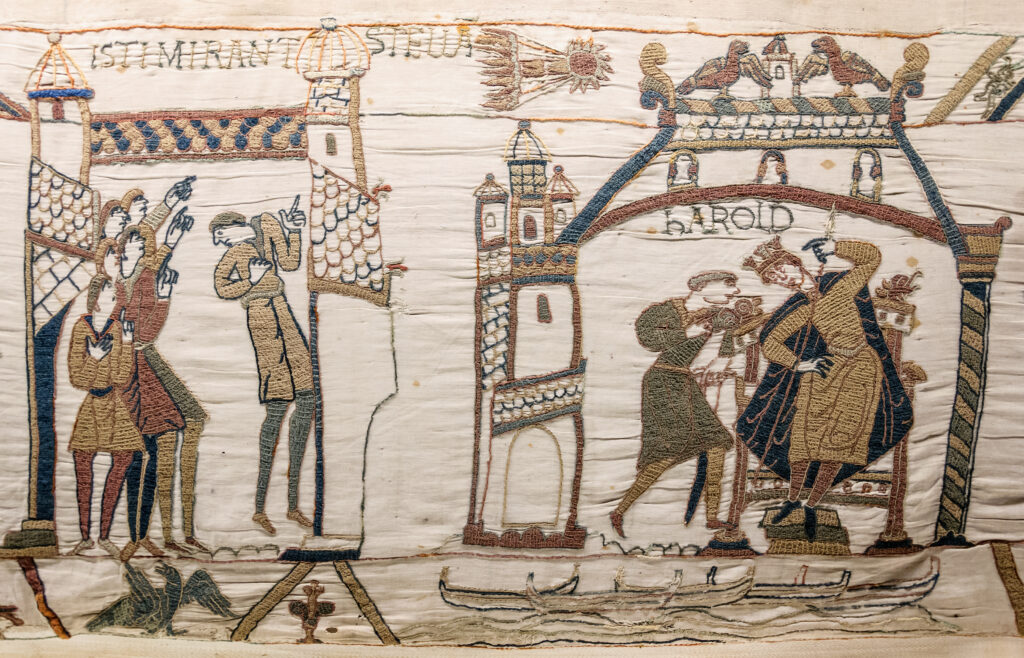
Convention calls it a tapestry, but it is technically embroidery: coloured wool worked onto linen in stem stitch and laid work. Its 58 surviving scenes move from Harold Godwinson’s journey to Normandy through oath, coronation, invasion and the Battle of Hastings. Latin captions drive the action, while borders filled with animals, labour, fables and violence create a second visual rhythm. Halley’s Comet appears as both recorded phenomenon and omen.
That sequential intelligence is central to the object’s contemporary pull. Figures cross scene boundaries, ships accelerate the story, and repeated gestures act almost like edits. The result is not simply a document of 1066, but a sustained experiment in image, text and pacing. Its usefulness to historians, from armour and shipbuilding to food and architecture, depends on the same concentration of observed detail that makes it artistically compelling.
Whose history is it?
The account is not neutral. British Museum curator Michael Lewis has described a propaganda element in its argument for Norman rule, yet the embroidery also preserves awkward human incident: stolen livestock, bodies stripped after battle, meals eaten from shields and a woman fleeing a burning house. Its margins complicate heroic history with comic, domestic and unsettling counterpoints.
The loan adds another layer. The object is owned in France, may have been commissioned by Bishop Odo of Bayeux, and was probably stitched by women in southern England. Its journey to London followed years of diplomacy and careful conservation planning. In exchange, French museums will receive loans from the Sutton Hoo collection, making the exhibition part of a wider conversation about shared, and sometimes disputed, heritage.
For opening-day viewers, that history became intensely physical: a famous image sequence could finally be read at the scale of its making. The British Museum presentation turns distance into the subject. Nearly 1,000 years after the conquest it depicts, the Bayeux Tapestry is again asking English audiences who controls a story, how images carry power and what survives when politics change.
Featured image: The Bayeux Tapestry, scenes 32-33, showing Halley’s Comet and Harold at Westminster. This image shows the artwork, not the 2026 London installation. Photograph: Myrabella, 7 March 2013, CC0 1.0, via Wikimedia Commons. The medieval embroidery is in the public domain.
