
On Saturday, 12 September, K20 in Düsseldorf opened Franz Marc: The Quest for a Better World, the first extensive solo exhibition devoted to the German Expressionist in a German museum for two decades. More than 120 paintings and works on paper bring a career of extraordinary speed and compression into one place.
Organised by the Kunstsammlung Nordrhein-Westfalen in cooperation with the Kunstmuseum Bern, the exhibition follows Marc from his early experiments of 1904 to the increasingly abstract compositions he made a decade later. The Düsseldorf presentation runs until 24 January 2027 before travelling to Bern.
A decade of restless invention
Marc co-founded the Blue Rider group with Wassily Kandinsky in 1911, but the familiar label can obscure how quickly his art kept changing. At K20, impressionistic beginnings give way to the charged animals and landscapes through which he pursued a more spiritual relationship with nature. Colour becomes structure as well as emotion; bodies and surroundings begin to fracture into the same rhythmic planes.
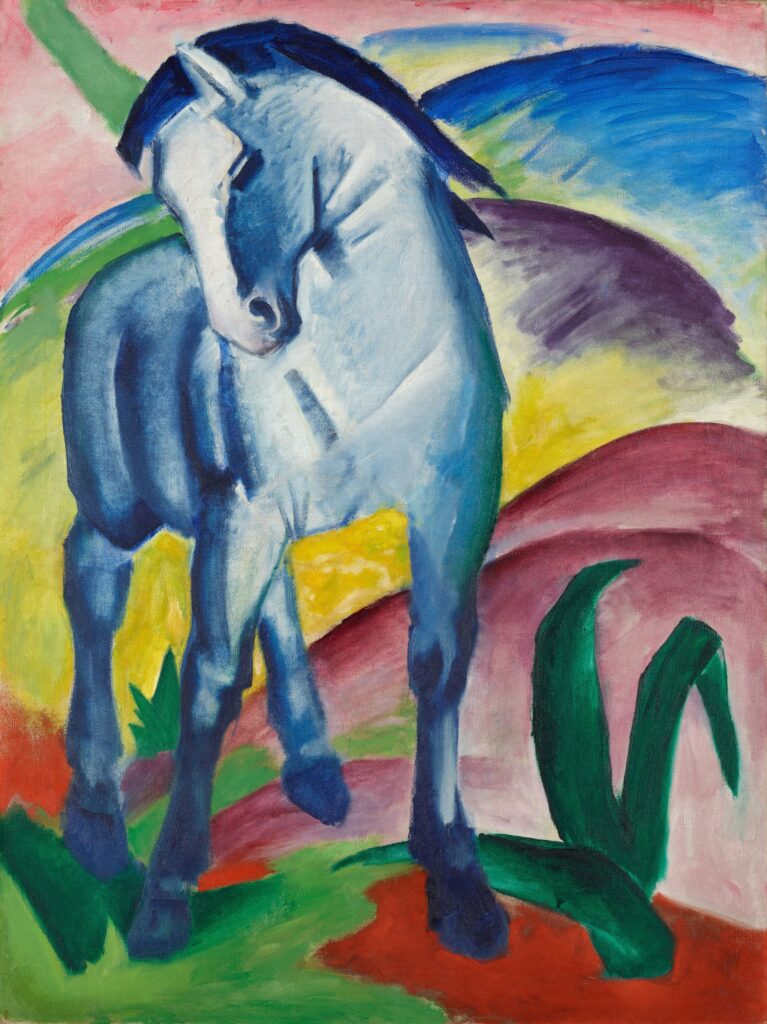
The loans include Blue Horse I, sent from Munich’s Lenbachhaus. Its cobalt animal is not simply a decorative emblem of Expressionism. In Marc’s work, the horse becomes a vehicle for imagining perception beyond the human world. The exhibition also brings together Blue Horse II, two works on paper associated with the Gurlitt trove, and studies connected to the lost Tower of Blue Horses, according to a review distributed by dpa.
The better world behind the colour
The title makes the exhibition’s argument explicit. Marc’s radiant animals belong to a larger search for an earthly paradise and a spiritual realm beyond the violence of the machine age. That aspiration becomes less serene in the later work, where crystalline forms carry darker, sometimes dystopian tensions. Seen together, the decade is not a straight march toward abstraction but a sustained attempt to remake the terms on which humans picture nature.
The historical frame matters. Marc volunteered for military service after the outbreak of the First World War and was killed near Verdun in 1916, aged 36. K20’s free audio guide is narrated by actor Felix Kammerer, whose role in All Quiet on the Western Front gives the choice a pointed resonance. The museum has also scheduled talks and events that extend the exhibition’s central question: what might a “better world” mean now?
That question prevents the show from becoming a procession of famous blue animals. Marc’s intense palette remains immediately seductive, but Düsseldorf places it alongside experimentation, doubt and rupture. Across more than 120 works, colour becomes an ethical proposition: a way to test whether painting can imagine another relationship between living beings and the world they share. The result is a retrospective that treats beauty as a problem to be tested, not a refuge from history.
Image: Franz Marc, Blue Horse I, 1911. Lenbachhaus, Munich. Public-domain artwork; faithful reproduction via Wikimedia Commons.