


Oxford’s Ashmolean Museum presented Aphrodite: The Making of a Goddess to the press on 5 October, three days before the exhibition opens to the public. Its premise is unusually ambitious: to follow one divine image across more than 5,000 years, from Bronze Age Cyprus to Renaissance painting, contemporary art and fashion.
More than 150 objects bring that transformation into view. Archaeology sits beside sculpture, painting and clothing, turning the exhibition into a study of how cultures repeatedly remade the goddess to express changing ideas about beauty, femininity, love and desire.
From Cyprus to Rome
The journey begins in the eastern Mediterranean, where the museum links Aphrodite to older female deities and to centuries of exchange between Cyprus, the Near East, Egypt and the Greek world. Among the earliest works is a copper-alloy figurine from around 1200 BCE in the Ashmolean’s own collection.
Ancient myths then give the goddess a public identity: her birth from the sea, the Judgement of Paris, the Trojan War and her relationships with Adonis and Anchises. Vases, jewellery and sculpture show how those stories travelled. A Roman mosaic from Tunisia, made around 200–250 CE, depicts Aphrodite sailing on a barge.
The exhibition also follows her transformation into Venus as Rome absorbed and redistributed Greek imagery. At the centre of that change is the female nude. A Crouching Aphrodite from the Royal Collection and a second-century Capitoline Venus lent by the Louvre reveal how a Greek sculptural model was copied across the Roman Empire and survived after its original disappeared.
An image that survives every reinvention
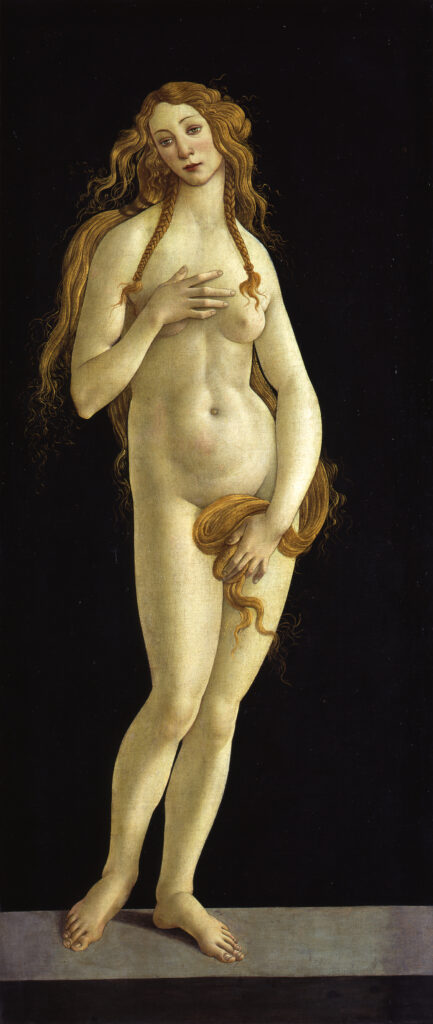
Botticelli’s Venus, painted with his workshop around 1490 and lent by Berlin’s Gemäldegalerie, brings the story into Renaissance Europe. Almost life-size against a dark ground, the goddess stands alone, her body and long golden hair recalling the pose made famous by The Birth of Venus. Stripped of narrative scenery, she becomes both an ancient type and a newly marketable icon.
The final stretch tests that image against modern culture. Michelangelo Pistoletto’s Venus of the Rags places classical beauty before a heap of discarded clothes, while works by Yves Klein and a Jonathan Anderson dress worn by Beyoncé show the goddess moving through conceptual art, luxury fashion and celebrity.
The first critical response has already exposed the risks of such a sweep. Writing after the press presentation, the Guardian praised the quality of the loans but argued that the chronology and the passage from Cypriot worship to the Western nude can feel disjointed. That tension may be the exhibition’s most revealing question: whether one figure can hold together religion, power, eroticism and commerce without being simplified by each new age.
Aphrodite: The Making of a Goddess opens at the Ashmolean Museum on 8 October 2026 and runs until 11 April 2027.
Featured image: Sandro Botticelli and workshop, Venus, c. 1490, Gemäldegalerie, Staatliche Museen zu Berlin. Faithful reproduction of a public-domain artwork, Public Domain Mark 1.0, via Wikimedia Commons.
_-_Venus_-_1124_-_Gem%C3%A4ldegalerie.jpg)