

The Museo Picasso Málaga has opened the first exhibition to place Edvard Munch and Pablo Picasso in sustained dialogue. Bringing together more than 100 paintings, prints and drawings, the show tests how two artists who never met transformed modern art by turning emotion into form.
The exhibition was inaugurated in Málaga on 29 October 2026, with Queen Sonja of Norway attending alongside Spanish and Norwegian cultural representatives. It opens to the public on 30 October and runs until 28 February 2027. Curated by Paloma Alarcó, it was organised with the Munchmuseet in Oslo and the Fundación Almine y Bernard Ruiz-Picasso.
A meeting built from affinities, not biography
Munch and Picasso occupied overlapping artistic worlds without developing a documented relationship. Munch saw Picasso’s work at the 1912 Sonderbund exhibition in Cologne, while Picasso probably encountered Munch’s art through exhibitions and the wider circulation of Symbolist and Expressionist ideas. Rather than inventing a personal connection, the Málaga exhibition builds its argument through works and recurring themes.
Across two floors, the display groups the artists around self-portraiture, landscape, the model, sexuality, illness, solitude and death. The comparison is not presented as a search for stylistic sameness. Munch’s vibrating line and charged colour often turn landscape into a psychological field; Picasso fractures bodies and viewpoints to keep perception unstable. Their routes differ, but both treated the human figure as a site of anxiety, desire and memory.
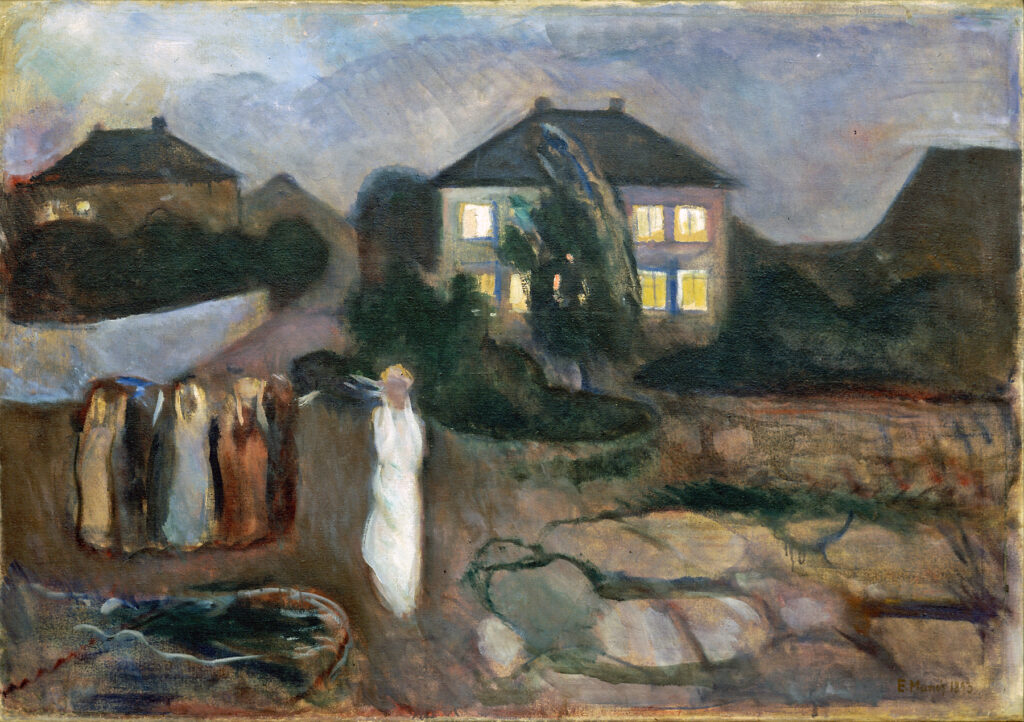
Among the works discussed in coverage of the opening is Munch’s The Storm (1893), in which a group of women stand outside a lit house on the Norwegian coast. The scene’s weather is also inward: isolation and collective fear are made visible without a literal narrative. Set beside Picasso’s changing approaches to bodies and space, the painting helps explain the exhibition’s central proposition—that modernism was shaped as much by emotional pressure as by formal innovation.
Modernism as an emotional language
The show includes loans from institutions including MoMA, Tate and the Museo Nacional Thyssen-Bornemisza. That range allows the curators to follow both artists across media and decades, from experimental printmaking to paintings in which surfaces were repeatedly reworked. Repetition matters here: Munch and Picasso returned to motifs, altered them and made familiar images carry new psychological weight.
The inauguration also underlined the cultural exchange behind the project. Queen Sonja described the exhibition as a bridge between Norwegian and Spanish culture, while the museum framed the event with restraint following the deadly rail disaster in Toledo. A planned gala dinner was cancelled, and the opening proceeded as a space for reflection rather than celebration.
Munch-Picasso does not depend on the claim that one artist directly influenced the other. Its value lies in showing how parallel experiments can illuminate a shared historical problem: how to represent inner life after inherited visual conventions no longer seemed sufficient. In Málaga, their works meet not as a tidy pairing, but as two unsettled accounts of what modern experience felt like.
Image credit: Edvard Munch, The Storm, 1893, oil on canvas, Museum of Modern Art, New York. Public domain / Public Domain Mark 1.0. The painting is included in the exhibition; the reproduction does not show the 2026 installation.
