
Opened in Paris on September 24, Histoires de paysages. De Monet à Hockney (1890–2026) asks what happens when landscape stops being a backdrop and becomes evidence. At the Musée Marmottan Monet, more than a century of images turns fields, coastlines and cities into records of changing ways of seeing—and of a changing world.
A landscape after Impressionism
The exhibition begins from a productive contradiction. Claude Monet helped loosen landscape from strict description, making atmosphere, duration and the act of painting visible. Yet the decades that followed also pushed artists to treat the land as social space, worked territory and political fact.
Organised across eleven chronological and thematic sections, the exhibition brings together painting, photography, video and installation. Its arc runs from the late nineteenth century to contemporary practice, moving between celebrated figures and less familiar voices. David Hockney appears in the title, but the argument is larger than a dialogue between two masters: landscape becomes a testing ground for modernity itself.
The route repeatedly crosses the boundary between art and document. Modernist experiments in colour and form meet photographs shaped by public commissions, while contemporary works register territories transformed by technology and climate. Those shifts make the exhibition a history of media as much as a history of scenery.
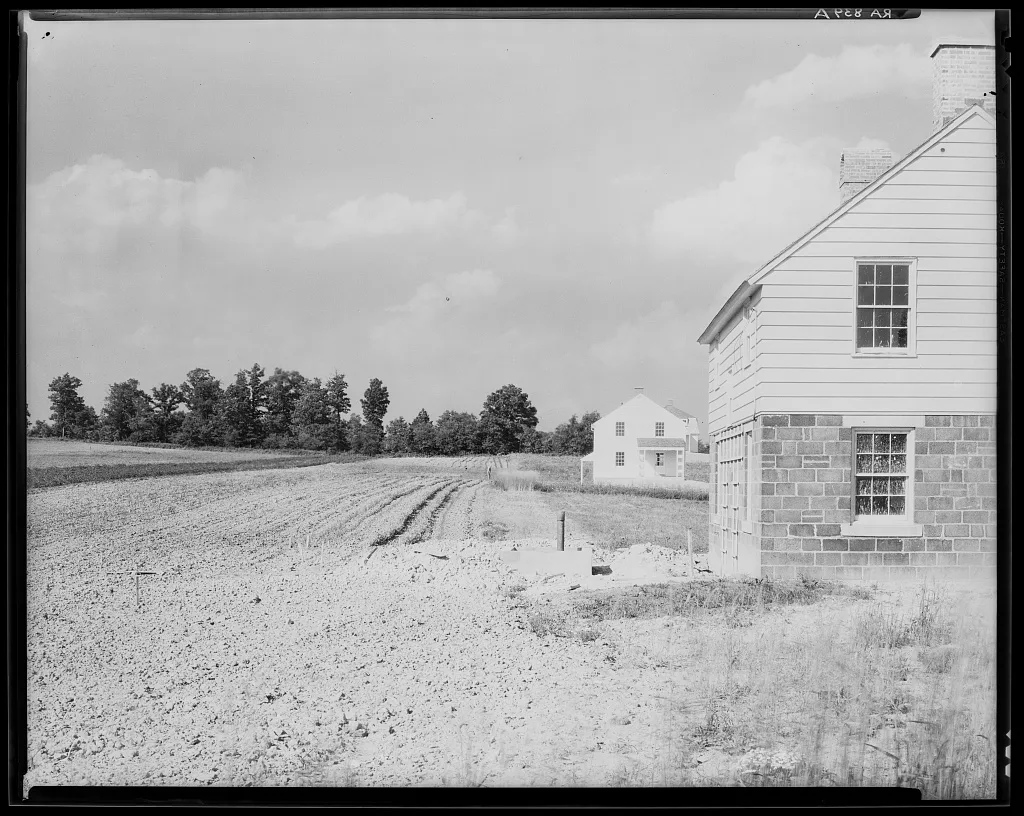
That breadth allows visual pleasure to sit beside pressure. Gardens and horizons remain, but so do cultivation, extraction, urbanisation and ecological disturbance. A 1935 photograph by Walker Evans, Homes and land cultivation. Arthurdale project. Reedsville, West Virginia, is especially telling. Made under the auspices of the US Farm Security Administration, it records a planned rural community rather than an untouched view. Included in the exhibition dossier, the image makes land legible as both environment and policy.
From motif to witness
The Musée Marmottan Monet is an unusually charged setting for this inquiry. Its collection is inseparable from Monet, whose landscapes often seem to dissolve the world into light. Histoires de paysages uses that inheritance as a point of departure rather than a destination, asking how later artists have carried the genre into photography, moving image and installation.
The result is also timely. As extreme heat and altered seasons reshape the places associated with Monet, the landscape tradition can no longer be treated as neutral scenery. Smithsonian Magazine reported this summer on the stress facing the artist’s garden at Giverny, a reminder that even art-historical landmarks are now climate records in the making.
The exhibition’s title promises a route from Monet to Hockney, but its strongest idea lies in the plural “histories.” No single view can stand for landscape. Every image is conditioned by who looks, who owns, who works and what is changing beyond the frame. By bringing 1890 and 2026 into the same conversation, the Marmottan presents landscape not as an escape from history, but as one of the places where history becomes visible.
Image: Walker Evans, Homes and land cultivation. Arthurdale project. Reedsville, West Virginia, June 1935. New York Public Library Digital Collections, CC0. The photograph is included in the 2026 exhibition.